
Tug Boat Fenders for Bow & Stern Protection
We manufacture vulcanized rubber tug boat fenders for the bow and stern, where a tug takes constant, hard contact during push and pull operations. The cylindrical body absorbs the impact at a low reaction force, using a combination of outer and inner diameters to spread the energy along the length and reduce hull wear. The high-performance rubber resists UV, seawater, and abrasion for long service, and we offer a range of sizes and customisable mounting. We have manufactured marine fenders in Qingdao since 2005, and we confirm the rubber grade — which sets the energy absorption and reaction force — against your tug’s duty.
Where Tug Boat Fenders Earn Their Place
Tug boat fenders suit the bow and stern of working tugs that push and pull other vessels and take constant contact and friction — provided the mounting position and the rubber grade are confirmed. We use them on harbour and project tugs, around ports and terminals, and in marine engineering and construction, and we size the fender and grade from the tug’s duty rather than from outer dimension alone.
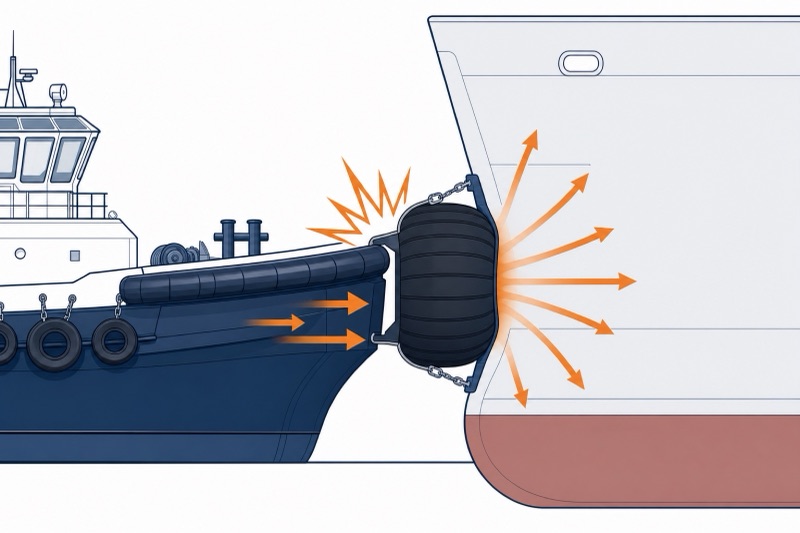
How the fender protects the tug
During push and pull operations the fender is squeezed between the tug and the vessel or quay. The rubber compresses and absorbs the impact at a low reaction force, and a combination of outer and inner diameters spreads the energy along the fender’s length so the load is shared rather than point-loaded into either hull.
That high energy at a low reaction is what protects the tug’s own structure and the vessel it works: it reduces hull wear and makes berthing and pushing steadier and safer. The fender is built to take this contact repeatedly, which is why the rubber and the vulcanization matter as much as the shape.
Why a fender built for the tug, not the quay. A tug fender mounts on the bow and stern and takes contact from any direction during push, pull, and escort work, so it is shaped and graded for that duty rather than for a fixed berth. For protecting a quay wall instead of a tug, a cylindrical or super cone rubber fender is the right type.
Tug protection (push & pull)
Built for the frequent, high-impact contact of push and pull work, spreading the force to protect the tug hull and keep operations steady.
Ports & terminals
Steady protection in busy ports across tidal conditions, cushioning berthing and reducing impact stress on quay equipment.
Marine engineering & construction
Protecting offshore structures, floating platforms, drilling rigs, and construction barges, with corrosion and ageing resistance for high-salt service.
TY Tug Cylindricals — Sizes & Geometry
The TY tug cylindrical is the standard pushing fender for the bow and stern, in ten sizes by outer diameter from Φ250 to Φ1000 mm. The table gives the body geometry, the tapered-end dimensions, and the weight per metre. Length is built to the tug, so weight is quoted per metre rather than per unit; the energy absorption and reaction force follow the rubber grade and the fitted length, which we confirm against the tug’s duty.
| ΦD | Φd | A max | B max | C | ΦG | ΦJ | Weight (kg/m) |
|---|---|---|---|---|---|---|---|
| 250 | 125 | 200 | 570 | 500 | 190 | 75 | 48 |
| 300 | 150 | 225 | 600 | 700 | 225 | 75 | 69 |
| 350 | 175 | 250 | 650 | 800 | 250 | 85 | 94 |
| 400 | 200 | 300 | 670 | 800 | 300 | 100 | 123 |
| 450 | 225 | 300 | 700 | 850 | 350 | 100 | 155 |
| 500 | 250 | 300 | 730 | 900 | 375 | 100 | 191 |
| 600 | 300 | 350 | 800 | 900 | 450 | 125 | 276 |
| 800 | 400 | 350 | 930 | 1000 | 600 | 125 | 490 |
| 900 | 450 | 350 | 1000 | 1100 | 675 | 150 | 620 |
| 1000 | 500 | 350 | 1060 | 1200 | 750 | 150 | 766 |
Dimensions in mm, weight in kg per metre. ΦD is the outer diameter and Φd the bore (consistently half of ΦD). A max and B max are the maximum tapered-end and mid-section lengths, C the section pitch, ΦG the tapered-end outer diameter, and ΦJ the tapered-end bore. Length is made to order to suit the tug, and the fender is supplied in sections along the run.
Fitting to the hull
Smaller fenders up to about Φ500 mm are normally fixed by a single longitudinal chain running through the bore, connected to the hull and tensioned with turnbuckles. Larger fenders generally add supplementary chains or straps. The tapered ends let the fender follow a flared hull without catching as the tug works alongside.
Choosing the fender by position on the tug
A working tug is rarely fitted with one fender type — each position takes a different kind of contact, and the fender is chosen for that duty.
Bow & stern — cylindrical
The TY tug cylindrical is the primary pushing fender at the bow and stern, and works equally well pushing flat-sided vessels as flared hulls.
Pushing faces — W, M, keyhole & square
Where the push needs a wide contact face at low hull pressure, W- and M-profiles, keyhole, and square sections spread the load, and their grooved faces grip well.
Side beltings — D, square & composite
Along the sides, D-section, square, and composite profiles run as belting to protect the hull during escort work.
The most common sizing mistake. Fitting one fender type all the way round the tug. The bow and stern want a cylindrical for pushing, the pushing faces want a wide W, M, keyhole, or square section for low hull pressure, and the sides want D or composite belting for escort work. We match each position to its duty rather than run one profile everywhere.
Know your tug and how it works?
Send the tug, the duty (push, pull, escort), and the mounting position — we size the fender and grade.
Construction & How They Are Fitted
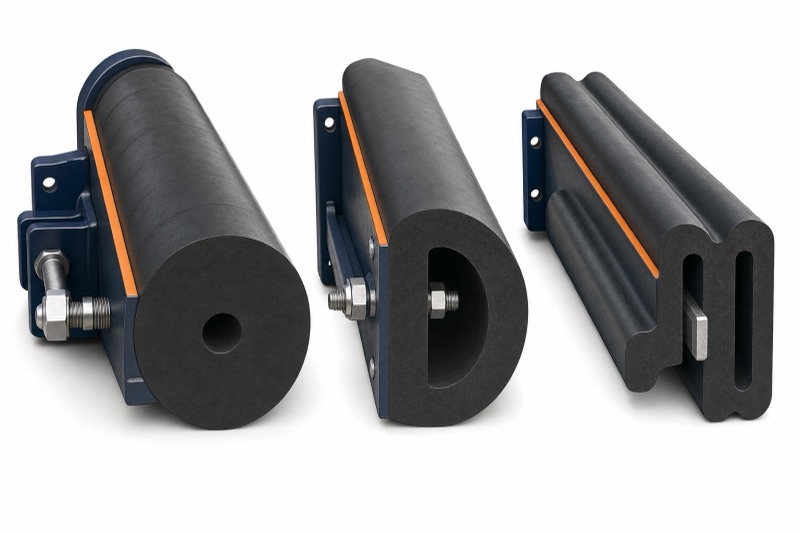
Vulcanized high-performance rubber
The fender is moulded from high-performance rubber and cured by a full vulcanization process, which is what gives it resistance to UV, seawater, and abrasion through frequent, hard contact. The cylindrical profile uses a combination of outer and inner diameters so the energy spreads along the length rather than concentrating at the contact point.
The cylindrical body is the standard profile, with tapered ends so it follows a flared hull without catching. Fenders up to about Φ500 mm fix with a longitudinal chain through the bore, tensioned to the hull with turnbuckles; larger sizes add supplementary chains or straps. Other profiles — W, M, keyhole, square, D, and composite — are supplied for pushing faces and side beltings.
Durability
Vulcanized rubber resists UV, seawater, and abrasion, holding its shape and function through frequent use and heavy impact without frequent replacement.
Versatility
A range of sizes and customisable materials and mounting fit different tugs and dock layouts, sized and configured to the job.
Low maintenance
Long service life and low maintenance reduce downtime and replacement, which is the operating-cost case for a quality tug fender.
When a Different Fender Fits Better
Tug boat fenders are one option in our wider rubber fenders range, built for the bow and stern of working tugs. They are not the fender for a fixed berth or a floating one, so here is where something else fits better.
You are fendering a fixed quay
For a fender bolted to a quay wall rather than a tug, a cylindrical, super cone, or D-type rubber fender is the right type.
You need a floating fender
For ship-to-ship transfer or a floating berth, a pneumatic fender or foam filled fender floats and suits that duty.
You need a wide, low-pressure push face
Where the tug pushes against a flat hull and hull pressure is the constraint, a W, M, keyhole, or square pushing profile spreads the load better than a cylindrical.
An honest boundary. Tug fenders work in harder conditions than any other fender type, and the geometry table does not by itself give an energy and reaction figure — those depend on the rubber grade, the fitted length, and how the tug actually works. We confirm them for the duty before contract rather than quote a catalogue number.
Tug Boat Fenders — Frequently Asked Questions
Where are tug boat fenders fitted?
At the bow, stern, and along the sides. Cylindricals go at the bow and stern as the primary pushing fenders, wide-face profiles (W, M, keyhole, square) where the push needs low hull pressure, and D, square, or composite belting along the sides for escort work.
What do they protect against?
The frequent, high-impact contact and friction of towing operations. The rubber absorbs the impact at a low reaction force and spreads it along the fender, reducing wear on the tug hull and the vessel or quay it works.
What are they made of?
High-performance rubber cured by a full vulcanization process, which resists UV, seawater, and abrasion so the fender holds its shape and function through frequent, hard use.
What sizes are available?
Ten TY cylindrical sizes by outer diameter, from Φ250 to Φ1000 mm, with the bore consistently half the outer diameter and weights from 48 to 766 kg per metre. Length is made to order. Other profiles — W, M, keyhole, square, D, and composite — are supplied for pushing faces and side beltings.
How is the energy absorption and reaction force set?
By the rubber grade, the fitted length, and the duty — not the outer diameter alone. Tug fenders work in more extreme conditions than any other fender type, so we issue the energy absorption and reaction force for the actual configuration rather than print one figure.
Can the fenders be customised?
Yes. We offer customised sizes, materials, and mounting to suit a unique tug type or a specialised operating environment, confirmed with you before manufacture.
Match the fender to the tug and its duty
A tug fender is right when its grade and size suit how the tug pushes, pulls, and escorts. Send us the tug and the duty and we return the size, the rubber grade, and the performance worked for the job — not a single catalogue figure.
What to send us
6 inputsYou get back: a recommended profile, size, and rubber grade with the energy absorption and reaction force for the duty, and the mounting method.