
Heavy Lifting Airbags for Caisson, Cofferdam & Heavy Structure Lifting
We manufacture heavy duty lifting airbags for contractors who move loads a single jack cannot reach safely — caissons up to 5,000 t and cofferdams up to 2,200 t handled as a system, with a single bag rated up to 1,000 t. Built from multi-layer synthetic tire-cord plies in diameters from 0.8 to 3.0 m and lengths from 6 to 20 m, they run at working pressures above 350 kPa and a compression rate up to 70%. We have manufactured marine airbags in Qingdao since 2005, and we size every set against your load and working height rather than a catalogue figure.
Where Heavy Lifting Airbags Earn Their Place
Heavy lifting airbags suit contractors lifting, aligning, or relocating heavy structures where a rigid jack would concentrate too much stress — provided you can confirm the load weight, the contact area under the load, and the working height available. We use them across shipbuilding, civil construction, salvage, and rapid logistics, and we size the type and quantity from your load case rather than the size of one bag.
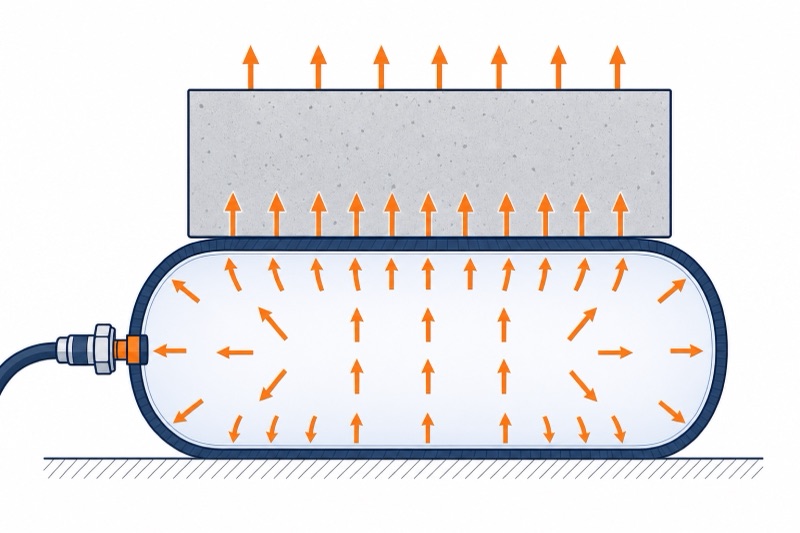
How the lift actually works
A heavy lifting airbag is a low-pressure, high-surface-area cushion: inflated under a load, it raises, pushes, pulls, or holds the structure while spreading the lifting force over a wide footprint. Because the bag conforms to the shape of the load, contact pressure stays low and the structure is not point-loaded.
That is the core difference from a hydraulic jack, which applies force over a small area and can stress or damage sensitive structures. We use the airbag’s low reaction force to keep fragile caissons, hulls, and precast sections within their allowable bearing stress during the lift.
Why a low-pressure airbag over a rigid jack. Airbags eliminate the chutes, carts, and skidding rigs a rigid lift needs, spread the load to protect the structure, and deflate flat for transport — installation needs only about 12 in (0.3 m) of clearance. The trade-off is that they need a reasonably even contact surface and a confirmed working height; we verify both before recommending them.
Construction & bridgework
Lifting and aligning large building materials and structural components, plus bridge construction and repair where point-loading is unacceptable.
Salvage & rescue
Raising heavy debris after collapses or accidents, and moving stranded vessels and large machinery where speed and even support matter.
Military & rapid logistics
A quick, mobile way to position or move large installations and heavy equipment without fixed lifting infrastructure on site.
S1, S2 and S3 Heavy Lifting Airbag Classes
We supply heavy lifting airbags in three layer classes that rise in synthetic-cord plies, working pressure, and bearing capacity — the same way ship-launching airbags step through QP, QG, and QS. The class sets how much load the bag carries per metre of effective length; we match the class to your load case rather than defaulting to the highest one, because a heavier class also means a stiffer, more expensive bag.
| Class | Sub-models | Relative cord plies | Positioning |
|---|---|---|---|
| S1 — Standard | S10 / S11 / S12 | Lower ply count | General lifting and moving of moderate loads |
| S2 — High Capacity | S20 / S21 / S22 | Higher ply count | Heavier structures needing higher working pressure |
| S3 — Ultra-High Capacity | S30 | Highest ply count | The most demanding lifts and heavy structure transport |
Standard diameters run 0.8–3.0 m with lengths 6–20 m; special sizes are available on request. Higher classes carry more load at the same diameter but need a confirmed working height to deliver it — see the bearing-capacity table below.
Know your load weight and working height?
Send them over and we calculate the airbag class, diameter, and quantity for your lift.
Bearing Capacity by Diameter & Working Height
Bearing capacity is given per metre of effective length (ton/m), so the total capacity of one bag is the table value multiplied by its effective length — the cylindrical working section, excluding the cone-shaped ends. Capacity also changes with working height: the more the bag is compressed (lower working height), the more it carries. We confirm the working height and pressure your lift will actually run at before we quote a class.
Reading the table. A figure such as 22.6 ton/m at D = 1.0 m, working height 0.40 m is per metre of effective length. A 1.0 m × 10 m S20 bag at that compression therefore carries roughly 22.6 × 10 = 226 t — but only at that working height. The total lift weight is then shared across the number of bags in contact, with a safety margin.
| Class | Model | D (m) | P (MPa) | Working height 0.4D / 0.5D / 0.6D (m) | Unit bearing capacity 0.4D / 0.5D / 0.6D (ton/m) |
|---|---|---|---|---|---|
| S1 | S10 | 0.8 | 0.20 | 0.32 / 0.40 / 0.48 | 15.1 / 12.6 / 10 |
| S1 | S10 | 1.0 | 0.16 | 0.40 / 0.50 / 0.60 | 15.1 / 12.6 / 10 |
| S1 | S10 | 1.2 | 0.14 | 0.48 / 0.60 / 0.72 | 15.8 / 13.2 / 10.6 |
| S1 | S10 | 1.5 | 0.11 | 0.60 / 0.75 / 0.90 | 15.5 / 13 / 10.4 |
| S1 | S11 | 0.8 | 0.19 | 0.32 / 0.40 / 0.48 | 14.3 / 11.9 / 9.5 |
| S1 | S11 | 1.0 | 0.15 | 0.40 / 0.50 / 0.60 | 14.1 / 11.8 / 9.4 |
| S1 | S11 | 1.2 | 0.13 | 0.48 / 0.60 / 0.72 | 14.7 / 12.2 / 9.8 |
| S1 | S11 | 1.5 | 0.10 | 0.60 / 0.75 / 0.90 | 14.1 / 11.8 / 9.4 |
| S1 | S12 | 0.8 | 0.24 | 0.32 / 0.40 / 0.48 | 18.1 / 15.1 / 12.1 |
| S1 | S12 | 1.0 | 0.19 | 0.40 / 0.50 / 0.60 | 17.9 / 14.9 / 11.9 |
| S1 | S12 | 1.2 | 0.16 | 0.48 / 0.60 / 0.72 | 18.1 / 15.1 / 12.1 |
| S1 | S12 | 1.5 | 0.13 | 0.60 / 0.75 / 0.90 | 18.4 / 15.3 / 12.2 |
| S1 | S12 | 1.8 | 0.10 | 0.72 / 0.90 / 1.08 | 17 / 14.1 / 11.3 |
| S2 | S20 | 1.0 | 0.24 | 0.40 / 0.50 / 0.60 | 22.6 / 18.8 / 15.1 |
| S2 | S20 | 1.2 | 0.20 | 0.48 / 0.60 / 0.72 | 22.6 / 18.8 / 15.1 |
| S2 | S20 | 1.5 | 0.16 | 0.60 / 0.75 / 0.90 | 22.6 / 18.8 / 15.1 |
| S2 | S20 | 1.8 | 0.13 | 0.72 / 0.90 / 1.08 | 22 / 18.4 / 14.7 |
| S2 | S20 | 2.0 | 0.12 | 0.80 / 1.00 / 1.20 | 22.6 / 18.8 / 15.1 |
| S2 | S21 | 1.0 | 0.27 | 0.40 / 0.50 / 0.60 | 25.4 / 21.2 / 17 |
| S2 | S21 | 1.2 | 0.23 | 0.48 / 0.60 / 0.72 | 26 / 21.7 / 17.3 |
| S2 | S21 | 1.5 | 0.18 | 0.60 / 0.75 / 0.90 | 25.4 / 21.2 / 17 |
| S2 | S21 | 1.8 | 0.15 | 0.72 / 0.90 / 1.08 | 25.4 / 21.2 / 17 |
| S2 | S21 | 2.0 | 0.14 | 0.80 / 1.00 / 1.20 | 26.4 / 22 / 17.6 |
| S2 | S22 | 1.0 | 0.31 | 0.40 / 0.50 / 0.60 | 29.2 / 24.3 / 19.5 |
| S2 | S22 | 1.2 | 0.26 | 0.48 / 0.60 / 0.72 | 29.4 / 24.5* / 19.6 |
| S2 | S22 | 1.5 | 0.20 | 0.60 / 0.75 / 0.90 | 28.3 / 23.6 / 18.8 |
| S2 | S22 | 1.8 | 0.17 | 0.72 / 0.90 / 1.08 | 28.8 / 24 / 19.2 |
| S2 | S22 | 2.0 | 0.15 | 0.80 / 1.00 / 1.20 | 28.3 / 23.6 / 18.8 |
| S2 | S22 | 2.5 | 0.12 | 1.00 / 1.25 / 1.50 | 28.3 / 23.6 / 18.8 |
| S3 | S30 | 1.0 | 0.35 | 0.40 / 0.50 / 0.60 | 33 / 27.5 / 22 |
| S3 | S30 | 1.2 | 0.29 | 0.48 / 0.60 / 0.72 | 32.8 / 27.3 / 21.9 |
| S3 | S30 | 1.5 | 0.23 | 0.60 / 0.75 / 0.90 | 32.5 / 27.1 / 21.7 |
| S3 | S30 | 1.8 | 0.19 | 0.72 / 0.90 / 1.08 | 32.2 / 26.8 / 21.5 |
| S3 | S30 | 2.0 | 0.17 | 0.80 / 1.00 / 1.20 | 32 / 26.7 / 21.4 |
| S3 | S30 | 2.5 | 0.14 | 1.00 / 1.25 / 1.50 | 33 / 27.5 / 22 |
Figures are manufacturer working values; total bag capacity = unit bearing capacity × effective length, and the lift is then shared across the bags in contact with a safety margin. Working pressure (P) falls as diameter rises within a model. Two items we confirm with the factory before contract: (1) the value marked * was a transcription typo in the source data (0.6D reading) and is read here as 24.5 ton/m pending confirmation; (2) for the same diameter, model S11 reads slightly below S10, so the S10/S11/S12 sub-model coding does not increase monotonically — we confirm the exact sub-model definition rather than assuming a higher number means higher capacity.
The most common sizing mistake. Quoting a single bearing-capacity number without its working height. The same bag can swing from 33 to 22 ton/m between 0.4D and 0.6D compression, so a figure copied without its working height can over- or under-size the set by a third. We always pin capacity to a stated working height and pressure.
Not sure which layer class your lift needs?
Tell us the load, contact area, and surface condition — we confirm the class and quantity before you commit.
Construction, Pricing & What Affects Service Life
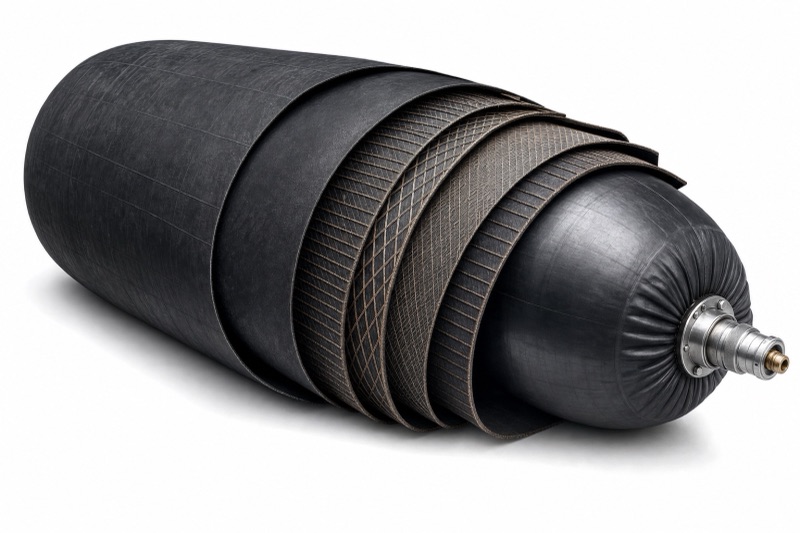
Synthetic tire-cord construction
Each bag is built from multiple layers of high-strength synthetic tire-cord ply between rubber, which is what lets it hold working pressures above 350 kPa and a compression rate up to 70%. The cord-ply count is what separates the S1, S2, and S3 classes, and it sets the safe working pressure for a given diameter.
Priced by surface area, not by the tonnage lifted: S = π × D × (D + effective length) × number of layers, then a unit price per m². We give you the worked surface area so the quotation is auditable rather than a single lump figure. Deflated, the bag is flat and needs only about 12 in of clearance to install.
Service life
Depends on usage frequency, storage, and ground conditions; correct care gives several years of service. We confirm your duty cycle so the class we recommend matches it, not just the next lift.
Maintenance
Inspect before and after each use for wear, tears, and punctures; wash with mild soap and water; check pressure with an accurate gauge against the spec for the lift.
Storage & shipping
Store cool, dry, and out of direct sun, away from oil, solvents, and sharp objects; avoid dragging over rough surfaces to prevent abrasion.
When a Different Product Fits Better
Heavy lifting airbags are one product in our wider marine airbags range, and they are not the right tool for every job. We would rather route you to the correct product than oversell these, so here is where something else fits better.
You need berth or quay protection
For fendering a vessel against a structure, use floating pneumatic fenders or fixed-dock rubber fenders — lifting airbags are not fenders.
You are launching or refloating
For slipway launch and haul-out use ship launching airbags; for refloating sunken or stranded objects use marine salvage airbags.
You need a permanent floating unit
For maintenance-free, permanently floating, puncture-resistant service, foam-filled fenders suit better than an inflatable airbag.
An honest boundary. Airbag lifting needs a reasonably even contact surface and a confirmed working height; on very uneven ground or where the contact area is too small for the load, we will say so and recommend a different method rather than push a class that cannot deliver safely.
Heavy Lifting Airbags — Frequently Asked Questions
How many heavy lifting airbags do I need?
The number follows your total load weight, the bags in contact under the load, and a safety margin — not the capacity of one bag. Send us the load weight, dimensions, contact area, and working height available, and we calculate the class, size, and quantity.
What do the S1, S2 and S3 classes mean?
They differ by synthetic cord-ply count, which rises from S1 to S3, with working pressure and bearing capacity rising as plies increase. We match the class to your load and working height rather than defaulting to the highest one.
Why does the same airbag show different bearing capacities?
Because capacity depends on working height. The more the bag is compressed (lower working height), the more it carries — the table shows each model at 0.4D, 0.5D, and 0.6D. Reading one figure without its working height is the most common sizing error we see.
How do I get total capacity from the table?
The table gives unit bearing capacity per metre of effective length (ton/m). Multiply by the effective length — the cylindrical working section, excluding the cone ends — to get one bag’s total capacity, then share the lift across the bags in contact with a safety margin.
Which standard applies — ISO 14409 or ISO 17682?
ISO 14409 is the product standard for the airbags themselves; ISO 17682 is the methodology standard for a launching operation. We build to the first, and when the bags are used to launch a vessel we align the plan with the second.
Can heavy lifting airbags also be used for ship launching or fendering?
They can assist launching, but for slipway launch and haul-out we supply purpose-built ship launching airbags. They are not fenders — for berth protection use pneumatic, foam-filled, or rubber fenders instead.
Size your lift on the load, not a catalogue figure
Bearing capacity only means something against a stated working height and pressure. Send us the load case and we return the class, size, and quantity worked from your numbers — not a single figure copied off a table.
What to send us
6 inputsYou get back: a recommended class, diameter, effective length, and quantity, with the worked surface-area basis for the quote.