Super Cone Rubber Fenders for High-Energy Berths
We manufacture super cone rubber fenders whose tapered geometry absorbs a high share of the berthing energy — about 70% to 72.5% — at a low reaction force, spreading the impact so the hull and the quay take less stress. They stay stable when the vessel berths at an angle of up to 10°, come in 14 sizes from 500H to 2000H weighing 142 to 9,200 kg, and bolt down with M24 to M56 anchors. The high-strength rubber resists UV, seawater corrosion, and abrasion. We have manufactured marine fenders in Qingdao since 2005, and we confirm the rubber grade — which sets the guaranteed energy absorption and reaction force — against your berthing energy.
Where Super Cone Rubber Fenders Earn Their Place
Super cone fenders suit higher-energy berths that need a lot of energy absorbed at a controlled reaction force — provided the foundation can take the anchor bolts and the rubber grade is confirmed. We use them on commercial and naval berths and offshore platforms for large vessels, and we size the cone and the rubber grade from your berthing energy rather than from height alone.
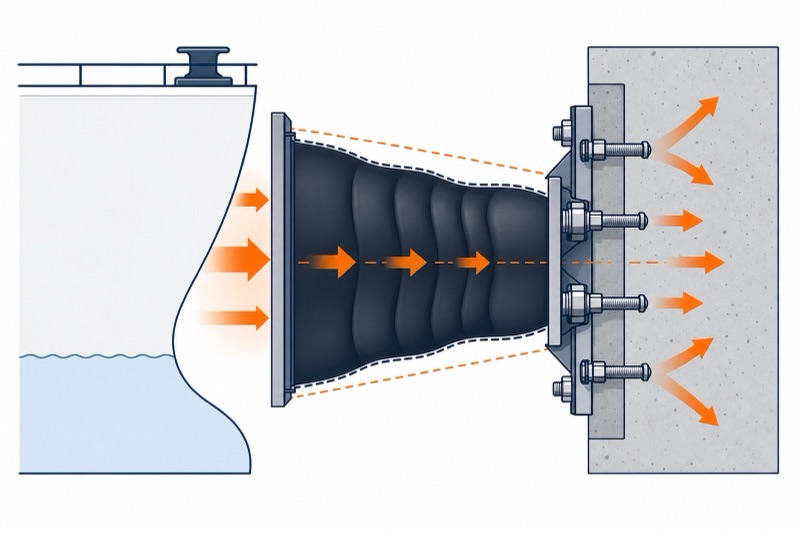
How the cone absorbs energy
The tapered cone is the energy element. As a vessel pushes against it, the cone deflects and the reaction force stays low while the geometry absorbs a high share of the berthing energy — about 70% to 72.5% — and disperses the impact so the hull and dock are not point-loaded. The shape also keeps the fender stable when the vessel berths at an angle of up to 10°.
That high energy at a low reaction is the reason to choose a cone over a simpler fender: it delivers far more energy for the reaction force it passes into the quay. The trade-off is that it is a bolted, fixed unit on a solid foundation, and its rated performance depends on the rubber grade we select for the berth.
Why a cone over a cylindrical fender. The cone absorbs much more energy for the same reaction force, which protects an old quay or a sensitive hull where the reaction limit is tight. The trade-off is a larger, bolted unit on a solid foundation; for simple, low-energy berths or workboats, a cylindrical rubber fender or tug boat fender is lighter and easier to fit.
Commercial ports & terminals
High energy absorption at low reaction for large cargo and passenger vessels, dispersing the berthing force to protect hull and quay across varied traffic.
Military & naval facilities
Heavy naval vessels and high-intensity use, handled with strong impact resistance and corrosion-resistant rubber.
Offshore platforms & oil and gas
Protection against vessel impact in harsh weather and strong currents, with high-salt corrosion resistance for long service.
Cone Sizes & How Performance Is Set
Super cone fenders come in 14 sizes by cone height, from 500H to 2000H. The energy absorption and reaction force at each size are set by the rubber grade, not by the geometry alone — a taller cone in a softer grade and a shorter cone in a harder grade can meet very different berths. The table below gives the geometry and anchor pattern; we provide the guaranteed energy absorption and reaction force per grade with the quote.
| Model | H (mm) | T (mm) | U (mm)* | φS (mm) | φB (mm) | φW (mm) | φd (mm) | Anchor bolts | Weight (kg) |
|---|---|---|---|---|---|---|---|---|---|
| 500H | 500 | 25 | 425 | 325 | 675 | 750 | 30 | 4-M24 | 142 |
| 600H | 600 | 27 | 510 | 390 | 810 | 900 | 30 | 6-M24 | 232 |
| 700H | 700 | 32 | 595 | 455 | 945 | 1050 | 38 | 6-M30 | 393 |
| 800H | 800 | 36 | 680 | 520 | 1080 | 1200 | 44 | 6-M36 | 540 |
| 900H | 900 | 41 | 765 | 585 | 1215 | 1350 | 44 | 6-M36 | 752 |
| 1000H | 1000 | 45 | 850 | 650 | 1350 | 1500 | 50 | 6-M42 | 1022 |
| 1100H | 1100 | 50 | 935 | 715 | 1485 | 1650 | 50 | 6-M42 | 1510 |
| 1150H | 1150 | 52 | 998 | 750 | 1550 | 1725 | 50 | 6-M42 | 1601 |
| 1200H | 1200 | 54 | 1020 | 780 | 1620 | 1800 | 50 | 8-M42 | 1960 |
| 1300H | 1300 | 59 | 1105 | 845 | 1755 | 1950 | 60 | 8-M48 | 2403 |
| 1400H | 1400 | 66 | 1190 | 930 | 1890 | 2100 | 60 | 8-M48 | 3060 |
| 1600H | 1600 | 72 | 1360 | 1060 | 2160 | 2400 | 70 | 8-M48 | 4605 |
| 1800H | 1800 | 78 | 1530 | 1190 | 2430 | 2700 | 76 | 10-M56 | 6608 |
| 2000H | 2000 | 80 | 1900 | 1540 | 2920 | 3200 | 76 | 10-M56 | 9200 |
Geometry and anchor pattern by model; weight is per fender. The “U” column header was garbled in the source data (shown there as “中U”), so we confirm that dimension on the certified drawing for your order. Energy absorption, reaction force, hull pressure, and the temperature and angular factors follow the rubber grade and are issued with the performance curves — not read off this geometry table.
The most common sizing mistake. Choosing a cone by height and forgetting the rubber grade. Two fenders of the same height in different grades give different energy and reaction, and the rated figures still derate for temperature and berthing angle. We pick the size and grade together against your berthing energy, then check reaction force and hull pressure.
Know your berthing energy and reaction limit?
Send the vessel, approach speed, and quay limit — we pick the cone size and rubber grade.
Construction & How They Are Mounted
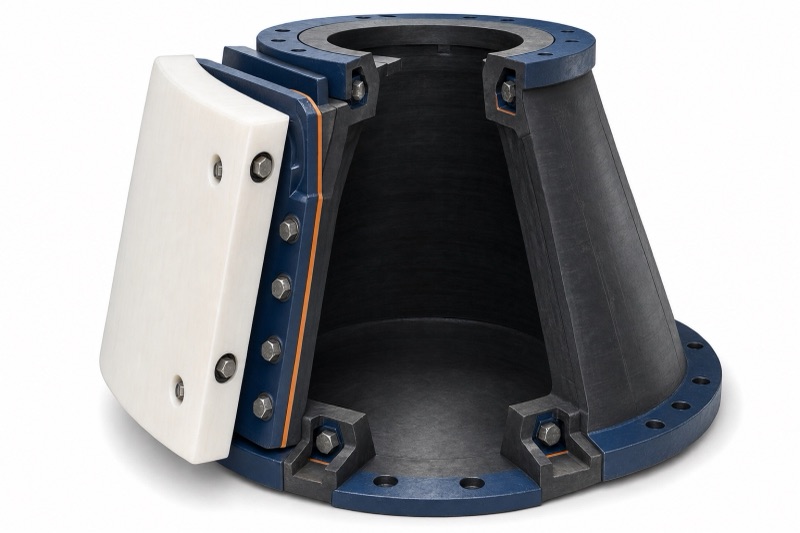
Moulded rubber cone, bolted down
The cone is moulded from high-strength rubber with anchor bolts from M24 to M56, four to ten per model depending on size, fixing it to a solid foundation. The rubber resists UV, seawater corrosion, and abrasion for long service in harsh marine environments.
Where a berth needs a wider contact face or a lower hull pressure, the cone is supplied with a steel front panel, often faced with a UHMW-PE pad — confirmed per project. We match the panel and the mounting hardware to your structure rather than leave them generic.
High-strength rubber
Resists UV, seawater corrosion, and abrasion, holding performance through frequent, high-intensity berthing in harsh conditions.
Anchor-bolt mounting
Bolted to a solid foundation with M24 to M56 anchors, four to ten per fender by model — we confirm the bolt pattern and torque with the structure.
Low maintenance, long life
Long service life and low maintenance reduce replacement frequency and cost, which is the economic case for the cone on a busy berth.
When a Different Fender Fits Better
Super cone fenders are one option in our wider rubber fenders range, built for high-energy fixed berths. They are not the right fender for every job, so here is where something else fits better.
You have a simple, low-energy berth
For general berths and workboats that do not need the cone’s energy, a cylindrical rubber fender or tug boat fender is simpler and cheaper.
You are tight on installation depth
Where the berth needs high energy in a shorter projection, a super cell rubber fender offers a similar energy class in a different geometry.
You have a floating berth
For a floating fender that rises with the tide rather than a fixed bolted one, a pneumatic fender or foam filled fender suits better.
An honest boundary. A cone fender needs a solid foundation for its anchor bolts and a confirmed rubber grade to deliver its rated performance. Until the grade and the temperature and angular factors for your berth are fixed, the energy and reaction figures are indicative — we confirm them before contract rather than quote a single catalogue number.
Super Cone Rubber Fenders — Frequently Asked Questions
How much energy does a super cone fender absorb?
About 70% to 72.5% of the berthing energy, at a low reaction force, dispersing the impact so the hull and dock take less stress. The exact guaranteed energy absorption follows the rubber grade we select for your berth.
What berthing angle can it handle?
The cone stays stable when the vessel berths at an angle of up to 10°. Beyond the rated angle, performance derates, so we apply an angular correction factor when we confirm the size and grade.
What sizes are available?
Fourteen sizes by cone height, from 500H to 2000H, weighing 142 to 9,200 kg, fixed with M24 to M56 anchor bolts (four to ten per fender by model). The geometry and anchor pattern are in the size table above.
How is the energy absorption and reaction force set?
By the rubber grade, not the geometry alone. The same cone height in a softer or harder grade gives different energy and reaction, so we issue the guaranteed energy absorption and reaction force per grade with the performance curves rather than print one figure.
Do temperature and angle change the performance?
Yes. Rated rubber-fender performance derates with temperature and with the berthing angle, so we apply temperature and angular correction factors to your case when we confirm the size and grade.
When should I use a cylindrical or cell fender instead?
Use a cylindrical fender for simple, low-energy berths and workboats where the cone’s energy is not needed. Consider a super cell fender where you need a similar energy class in a different projection. The cone suits high-energy berths with a tight reaction limit.
Pick the cone and the grade on your berthing energy
A cone fender is right when its energy absorption covers your berthing energy while the reaction stays within the quay’s limit. Send us the vessel and the berth and we return the size, the rubber grade, and the guaranteed performance — not a single catalogue figure.
What to send us
6 inputsYou get back: a recommended cone size and rubber grade with guaranteed energy absorption and rated reaction force, corrected for temperature and angle, plus the anchor pattern.