
V Type Arch Rubber Fenders for Cargo, RoRo & Marina Berths
We manufacture V type rubber fenders — one-piece moulded arch fenders whose V-groove spreads the contact pressure evenly, improves grip, and lowers the reaction force, with high longitudinal shear resistance for stable berthing. They come in heights from 150 to 1,000 mm and lengths from 1,000 to 3,500 mm, in natural rubber or PU that resists abrasion, corrosion, UV, and weather, with an optional UHMW-PE or steel front panel to raise energy absorption and cut maintenance. The rubber is tested to ISO methods, the service life is 8 to 10 years, and the fenders are type-approved by major classification societies (CCS, BV, ABS, LR) under an ISO 9001 system. We have manufactured marine fenders in Qingdao since 2005, and we confirm the rubber grade and panel against your berthing energy.
Where V Type Arch Fenders Earn Their Place
V type arch fenders suit general berths that need solid energy absorption at a low reaction force with strong shear resistance — provided the rubber grade and any panel are confirmed. We use them on general cargo and RoRo berths, marinas, barge and tug berths, and at quay corners, locks, and pier ends, and we size the fender and grade from your berthing energy rather than from height alone.
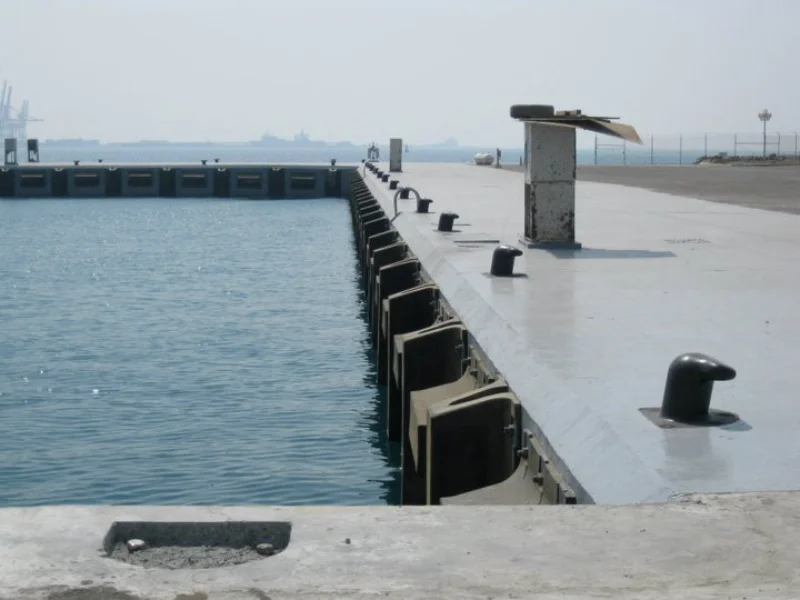
How the arch absorbs energy
The arch deflects under the vessel: its angled legs flex and buckle, absorbing the berthing energy, while the V-groove spreads the contact pressure evenly across the face. That even pressure improves the vessel’s grip on the fender and significantly lowers the reaction force passed into the quay compared with a solid block of the same height.
The arch also gives high longitudinal shear resistance, so it stays stable when the hull moves along the face — which is why it suits rotating dolphins and pivot points. An optional UHMW-PE or steel front panel raises the energy absorption further and lowers the friction against the hull.
Why an arch over a cone or cell. The arch is a low-profile, economical fender with excellent shear resistance and a low reaction force, well suited to general berths, corners, and pivot points. The trade-off is lower peak energy than a cone or cell; for a high-energy berth taking the largest vessels, a super cone or super cell rubber fender is the right type.
General cargo & RoRo
General cargo terminals, RoRo berths, multi-purpose terminals, and passenger ship berths, protecting hull and structure across mixed traffic.
Corners, locks & pier ends
Quay corners and turning points, lock and dry-dock entrances, and pier ends, where the arch’s shear resistance handles angled and sliding contact.
Barge, tug & workboat berths
Barge, tug, and workboat berths and rotating dolphins, where a low-profile, low-reaction fender protects both the craft and the structure.
Material Specification & How Performance Is Set
The arch is one-piece moulded in nine standard heights from 150H to 1000H, in lengths from 1,000 to 3,500 mm. Performance is set by the height and the rubber grade — RS super-high, RH high, RO standard, and RL low reaction — so the same height gives four reaction levels for the same envelope. The tables below give rated reaction force and energy absorption per metre of length, plus the PIANC correction factors we apply to your site.
DA super arch — rated performance by grade (52.5% deflection)
| Grade | Value | 150H* | 200H | 250H | 300H | 400H | 500H | 600H | 800H | 1000H |
|---|---|---|---|---|---|---|---|---|---|---|
| RS — Super high | R (kN/m) | 129 | 170 | 270 | 325 | 430 | 540 | 645 | 864 | 1080 |
| E (kN·m/m) | 7 | 11 | 28 | 41 | 73 | 113 | 163 | 290 | 450 | |
| RH — High | R (kN/m) | 112 | 150 | 208 | 248 | 330 | 415 | 495 | 664 | 830 |
| E (kN·m/m) | 6 | 12 | 22 | 31 | 55 | 87 | 125 | 223 | 349 | |
| RO — Standard | R (kN/m) | 84 | 112 | 172 | 206 | 275 | 344 | 412 | 550 | 688 |
| E (kN·m/m) | 4 | 10 | 18 | 26 | 46 | 72 | 104 | 185 | 289 | |
| RL — Low | R (kN/m) | 56 | 75 | 148 | 175 | 235 | 295 | 354 | 472 | 590 |
| E (kN·m/m) | 3 | 6 | 16 | 22 | 40 | 62 | 89 | 159 | 248 |
Rated reaction force (R) and energy absorption (E) per metre of fender length at 52.5% rated deflection; maximum deflection 55%. *150H is rated at 45% deflection. For other lengths, multiply the 1,000 mm figures by the length factor. Tolerance: reaction force ≤ +10%, energy absorption ≥ -10%. RS = super high reaction, RH = high, RO = standard, RL = low.
DAF — with UHMW-PE face pad or steel frontal panel (50% deflection)
The DAF variant fits a UHMW-PE face pad or a steel frontal panel on top of the arch, for higher abrasion resistance and lower hull friction. It is rated at 50% deflection and carries its own performance set.
| Grade | Value | 150H | 200H | 250H | 300H | 400H | 500H | 600H | 800H | 1000H |
|---|---|---|---|---|---|---|---|---|---|---|
| RS — Super high | R (kN/m) | 181 | 241 | 257 | 326 | 413 | 511 | 613 | 831 | 1015 |
| E (kN·m/m) | 7 | 13 | 24 | 35 | 64 | 102 | 133 | 265 | 417 | |
| RH — High | R (kN/m) | 155 | 208 | 196 | 242 | 316 | 401 | 462 | 621 | 788 |
| E (kN·m/m) | 6 | 11 | 19 | 27 | 49 | 78 | 108 | 200 | 312 | |
| RO — Standard | R (kN/m) | 116 | 157 | 165 | 200 | 261 | 354 | 386 | 510 | 655 |
| E (kN·m/m) | 5 | 8 | 15 | 21 | 41 | 64 | 83 | 150 | 262 | |
| RL — Low | R (kN/m) | 78 | 103 | 144 | 158 | 229 | 269 | 299 | 456 | 539 |
| E (kN·m/m) | 3 | 6 | 12 | 16 | 31 | 54 | 71 | 126 | 221 |
Rated performance per metre of length at 50% deflection. Tolerance: reaction force ≤ +10%, energy absorption ≥ -10%.
PIANC correction factors
Rated figures are corrected for berthing angle, site temperature, and impact duration before the fender is confirmed. These are the factors we apply.
| Angular factor (AF) | Temperature factor (TF) | Velocity factor (VF) | |||
|---|---|---|---|---|---|
| Angle (°) | AF | Temp (°C) | TF | Time (s) | VF |
| 0 | 1.000 | +50 | 0.882 | 1 | 1.014 |
| 3 | 0.963 | +40 | 0.926 | 2 | 1.005 |
| 5 | 0.952 | +30 | 0.969 | 3 | 1.004 |
| 8 | 0.939 | +23 | 1.000 | 4 | 1.003 |
| 10 | 0.924 | +10 | 1.056 | 5 | 1.003 |
| 15 | 0.817 | 0 | 1.099 | 6 | 1.002 |
| 20 | 0.535 | -10 | 1.143 | 8 | 1.000 |
| -20 | 1.186 | ≥10 | 1.000 | ||
| -30 | 1.230 | ||||
Angular, temperature, and velocity factors are applied to the rated figures for your site conditions. Reference temperature is +23 °C (TF = 1.000) and reference angle is 0° (AF = 1.000).
Rubber material specification
| Property | Unit | Test method | Requirement |
|---|---|---|---|
| Tensile strength | MPa | ISO 37 | ≥16 |
| Elongation at break | % | ISO 37 | ≥350 |
| Tear strength | N/mm | ISO 34-1 (Graves) | ≥70 |
| Hardness | HA | ISO 868 | ≤78 |
| Compression set | % | ISO 815 | ≤30 |
| Ozone resistance | — | ISO 1431-1 | No cracks |
| Volume change in oil | % | ISO 1817 | ≤10 (optional) |
| Volume change in seawater | % | ISO 1817 | -5 to +10 (optional) |
| Abrasion resistance | mm³ | ISO 4649 | ≤100 (optional) |
| Bond strength | N/mm² | ISO 814 | ≥7 (optional) |
| Dynamic fatigue | — | ISO 132 | Grade 0-1 (optional) |
| Low-temperature resistance | — | ISO 812 | Pass (optional) |
Material specification of the rubber, tested to ISO methods; “optional” requirements are confirmed when your project calls for them. This is the material-conformance table that backs the durability and service life — the rated energy and reaction are in the performance tables above. Heights run 150H–1000H and lengths 1,000–3,500 mm; other colours are available.
The most common sizing mistake. Reading the rated table straight. The figures are per metre at 52.5% deflection and 23 °C; a cold fender is stiffer, an angled berthing compresses unevenly, and a short fender absorbs proportionally less. We apply the angular, temperature, and velocity factors and check reaction force and hull pressure against your structure and hull.
Body Dimensions, Face Pads & Anchor Hardware
The arch body, the face pad or frontal panel, and the cast-in anchor hardware are all sized together from the fender height. These are the standard reference dimensions; final drawings are issued against your structural details.
Arch body dimensions
| Size | H | W | B | F | C | D | P | Q | M | G |
|---|---|---|---|---|---|---|---|---|---|---|
| 150H | 300 | 240 | 98 | 96 | 22 | 50 | 95 | 25 | 55 | 150 |
| 200H | 400 | 320 | 150 | 128 | 24 | 58 | 105 | 29 | 75 | 200 |
| 250H | 500 | 410 | 187 | 160 | 30 | 64 | 125 | 32 | 90 | 250 |
| 300H | 600 | 490 | 225 | 195 | 33 | 70 | 140 | 35 | 105 | 300 |
| 400H | 800 | 670 | 300 | 260 | 40 | 82 | 165 | 41 | 120 | 400 |
| 500H | 1000 | 840 | 375 | 325 | 45 | 94 | 180 | 47 | 140 | 500 |
| 600H | 1200 | 1010 | 450 | 390 | 54 | 100 | 195 | 50 | 160 | 600 |
| 800H | 1600 | 1340 | 600 | 520 | 72 | 136 | 270 | 68 | 260 | 800 |
| 1000H | 1850 | 1550 | 650 | 580 | 52 | 108 | 290 | 54 | 300 | 1000 |
All dimensions in mm. Standard lengths run 1,000 / 1,500 / 2,000 / 2,500 / 3,000 / 3,500 mm, with the mounting-hole count (n) rising from 2 at 1,000 mm to 6 at 3,500 mm.
Face pad & frontal panel fixing
| Size | U | V | C | Bolt | PE X | PE Y | PE T | Panel X | Panel Y | Panel bolt |
|---|---|---|---|---|---|---|---|---|---|---|
| 150H | 0 | 20~30 | 30 | M16 | 49 | 60~70 | 300~410 | 70~150 | 250~300 | M16 |
| 200H | 0 | 30~45 | 30 | M16 | 65 | 60~70 | 300~410 | 70~150 | 250~300 | M16 |
| 250H | 64 | 30~45 | 30 | M16 | 50 | 60~85 | 300~410 | 70~150 | 250~300 | M20 |
| 300H | 105 | 30~45 | 40 | M16 | 60 | 65~85 | 300~410 | 70~150 | 250~300 | M24 |
| 400H | 180 | 30~50 | 40 | M16 | 60 | 65~85 | 300~410 | 70~150 | 250~300 | M27 |
| 500H | 245 | 30~50 | 50 | M20 | 65 | 65~85 | 300~410 | 70~150 | 250~300 | M30 |
| 600H | 310 | 35~60 | 50 | M20 | 70 | 65~85 | 300~410 | 70~150 | 250~300 | M30 |
| 800H | 440 | 50~70 | 60 | M24 | 80 | 65~85 | 300~410 | 70~150 | 250~300 | M36 |
| 1000H | 570 | 50~70 | 60 | M24 | 90 | 65~85 | 300~410 | 70~150 | 250~300 | M36 |
All dimensions in mm. Data given here is for guidance — if in doubt, contact us for the project drawing.
Precast nut & anchor hardware (Type I)
Used for installing fenders into newly poured concrete. A Type II anchor-bolt set is available for other fixing conditions.
| Size | MD | H | J | S | N | n | M | P | t | V | r | a | b | e | T | L | G |
|---|---|---|---|---|---|---|---|---|---|---|---|---|---|---|---|---|---|
| 150H | M22 | 14 | 55 | 50 | 68 | 12 | 60 | 23 | 5 | 24 | 10 | 50 | 75 | 31 | 6 | 165 | 50 |
| 200H | M24 | 15 | 65 | 55 | 74 | 14 | 80 | 33 | 5 | 26 | 10 | 59 | 85 | 34 | 6 | 180 | 55 |
| 250H | M27 | 17 | 65 | 60 | 88 | 16 | 95 | 42 | 5 | 30 | 15 | 60 | 90 | 37 | 9 | 200 | 55 |
| 300H | M30 | 19 | 85 | 70 | 100 | 19 | 110 | 47 | 5 | 37 | 15 | 85 | 120 | 42 | 9 | 300 | 80 |
| 400H | M36 | 23 | 95 | 80 | 119 | 22 | 126 | 52 | 6 | 43 | 25 | 85 | 125 | 48 | 9 | 360 | 85 |
| 500H | M42 | 26 | 110 | 90 | 127 | 25 | 145 | 56 | 6 | 49 | 30 | 95 | 140 | 58 | 12 | 420 | 110 |
| 600H | M48 | 30 | 110 | 100 | 139 | 28 | 165 | 61 | 6 | 52 | 30 | 95 | 145 | 65 | 12 | 480 | 115 |
| 800H | M64 | 40 | 150 | 120 | 195 | 32 | 266 | 124 | 8 | 70 | 40 | 125 | 190 | 78 | 16 | 640 | 130 |
| 1000H | M64 | 40 | 150 | 120 | 215 | 36 | 306 | 134 | 8 | 70 | 40 | 125 | 190 | 78 | 16 | 640 | 130 |
All dimensions in mm. Hex bolt (MD, H, J, S), L-washer (N, n, M, P, t, V, r), precast nut (a, b, e), and anchor rod / plate (T, L, G).
Know your berth and vessels?
Send the vessel, approach speed, and berth type — we pick the arch height, grade (RS/RH/RO/RL), and panel.
Construction, Panel Options & Mounting
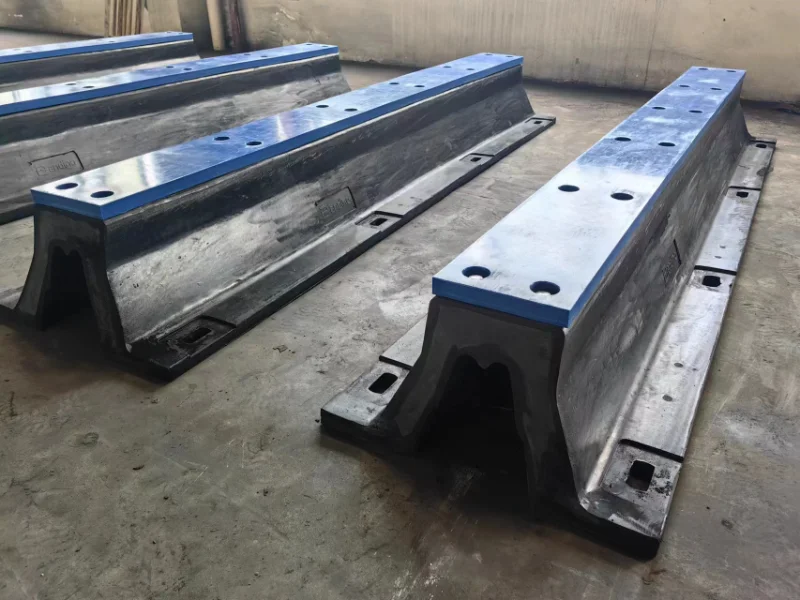
One-piece moulded arch
The fender is moulded in one piece from high-quality natural rubber or PU, with no joints to fail, for resistance to abrasion, corrosion, UV, and weather. The wide base flanges carry the bolt fixing, and the fender mounts either vertically or horizontally to suit the berth.
Where you need more energy or a lower-friction face, the arch takes an optional UHMW-PE or steel front panel — the UHMW-PE pad cuts the friction against the hull and raises the energy absorbed. We confirm the panel, the fixing, and the bolt pattern with the structure rather than leave them generic.
V-groove design
Spreads the contact pressure evenly, improves grip, and lowers the reaction force, with high longitudinal shear resistance for sliding and angled contact.
UHMW-PE or steel panel
An optional front panel raises the energy absorption and, with a UHMW-PE face, lowers the friction against the hull and cuts maintenance.
One-piece, easy to fit
One-piece moulding with vertical or horizontal mounting keeps installation simple and maintenance low over an 8-to-10-year life.
When a Different Fender Fits Better
V type arch fenders are one option in our wider rubber fenders range, built for general berths that value low reaction and shear resistance. They are not the highest-energy fender, so here is where something else fits better.
You have a high-energy berth
For the largest vessels needing the highest energy absorption, a super cone or super cell rubber fender delivers more energy at a controlled reaction.
You need simple edge protection
For light, continuous edge protection on a marina or pontoon, a cylindrical or D type rubber fender is simpler and cheaper.
You have a floating berth
For a floating fender that rises with the tide rather than a fixed bolted one, a pneumatic fender or foam filled fender suits better.
An honest boundary. The rated tables are per metre at a fixed deflection; real berths differ. We apply the PIANC angular, temperature, and velocity factors, then check reaction force and hull pressure against your structure and hull before contract rather than quote a single rated number.
V Type Rubber Fenders — Frequently Asked Questions
What is a V type (arch) rubber fender?
A one-piece moulded fender with a V-shaped arch section. The arch flexes to absorb berthing energy and the V-groove spreads the contact pressure evenly, improving grip and lowering the reaction force, with high longitudinal shear resistance for sliding and angled contact.
Where are V type fenders used?
On general cargo and RoRo berths, multi-purpose and passenger terminals, barge, tug, and workboat berths, and at quay corners, lock and dry-dock entrances, pier ends, and rotating dolphins or pivot points.
Can a front panel be fitted?
Yes. An optional UHMW-PE or steel front panel raises the energy absorption; a UHMW-PE face also lowers the friction against the hull and cuts maintenance. We confirm whether a panel suits your berth.
What sizes and materials are available?
Nine standard heights from 150H to 1000H (body height 300–1,850 mm) in lengths of 1,000 to 3,500 mm, in high-quality natural rubber or PU. The standard colour is black, with other colours available, and the rubber is tested to ISO methods.
How is the energy absorption and reaction force set?
By the height and the rubber grade — RS, RH, RO, or RL — with the DAF panel variant rated separately. The tables give rated values per metre at 52.5% deflection (50% for DAF); we then apply the PIANC angular, temperature, and velocity factors for your site.
When should I use a cone or cell fender instead?
When the berth needs the highest energy absorption for the largest vessels. The arch is a low-profile, low-reaction, shear-resistant fender for general berths; a super cone or super cell fender delivers more energy for a high-energy berth.
Pick the arch and grade on your berthing energy
An arch fender is right when its grade and height meet your berthing energy at a low reaction with the shear resistance the berth needs. Send us the vessel and berth and we return the height, grade, and panel with the performance worked for the job.
What to send us
6 inputsYou get back: a recommended arch height, rubber grade, and front panel with energy absorption and reaction force corrected for temperature and angle, and the mounting method.