
Pneumatic Fenders for Ship-to-Ship Transfer & Tidal Berthing
We manufacture Yokohama-type pneumatic fenders — air-filled, synthetic-tire-cord-reinforced floating fenders — for ship-to-ship (STS) transfer and ship-to-dock berthing where tidal range and standoff distance govern fender size. We build to ISO 17357-1:2014 in two initial-pressure ratings, Pneumatic 50 kPa and Pneumatic 80 kPa, and confirm guaranteed energy absorption and reaction force against your berthing energy before we quote. This page sets out what we supply, the data we verify before order, and the cases where a different fender type fits better.
The Pneumatic Fender Types We Supply
We supply three pneumatic fender types. Standard Yokohama net-type fenders cover STS transfer and tidal berthing, with full performance data further down this page and a dedicated page of their own. Where a standard surface fender is not the right fit, the two specialized types handle below-waterline contact and lighter, faster redeployment — choose by where the fender makes contact and how the hull must be handled.
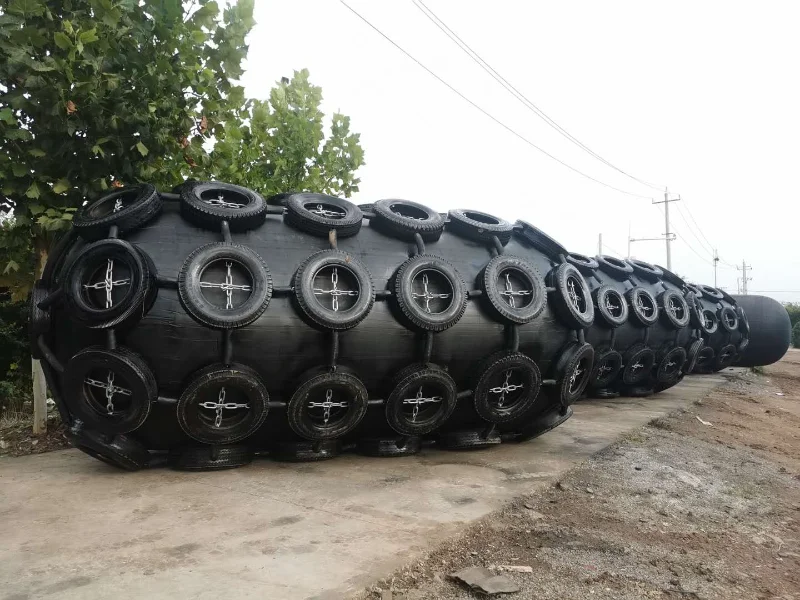
Yokohama Fenders
The standard net-type pneumatic fender — an air-filled, synthetic-tire-cord-reinforced body inside a chain-and-tire net. Built to ISO 17357-1:2014 in Pneumatic 50 kPa and Pneumatic 80 kPa, in diameters from 400 mm to 4,500 mm.
Best when: STS transfer and tidal berthing — high-cycle service against rough or abrasive quay faces.
View Yokohama Fenders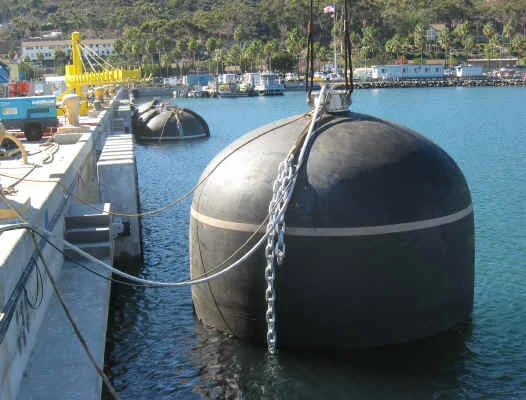
Submarine Fender
A hydro-pneumatic fender for below-waterline and submarine contact, where a surface floating fender cannot maintain the contact point. Ballasted to sit partly submerged and hold standoff under the waterline.
Best when: contact is below the waterline — submarine berthing, deep-draft or submerged-structure standoff.
View Submarine Fender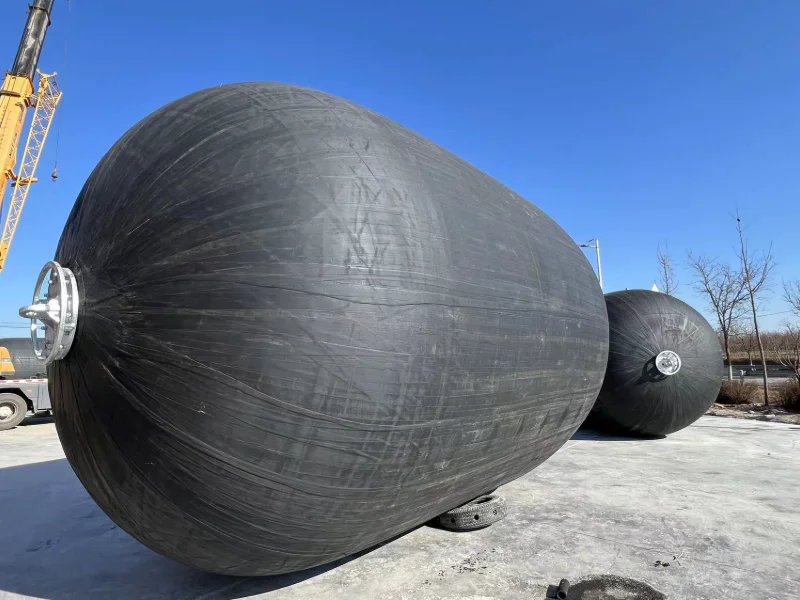
Sling Pneumatic Fender
A sling-type fender that drops the chain-and-tire net for lighter weight and faster deployment. Suits temporary berthing and vessels with sensitive or non-marking hull requirements.
Best when: temporary berthing, lighter handling, or a non-marking hull — surface contact at the waterline.
View Sling Pneumatic FenderWhere Our Pneumatic Fenders Fit
We supply pneumatic fenders for STS transfer, FSRU/LNG support, and tide-affected berthing — suited to tanker, gas-carrier, and offshore operators whose final fender size depends on vessel displacement, approach speed, and the standoff distance required for cargo handling.
Ship-to-Ship (STS) Transfer
Air-filled floating fenders maintain standoff and absorb berthing energy between two vessels alongside during cargo transfer.
FSRU / LNG Support
Sized for gas-carrier and offshore service where reaction force and hull pressure must stay within a tight design allowance.
Tide-Affected Berthing
Because the fender floats on an unrestricted vertical plane, it follows tide and vessel movement — the reason operators choose it over fixed quay fenders at berths with large tidal swing.
High energy absorption is only one of three quantities. The advantage buyers usually want is high energy absorption at comparatively low reaction force and low hull pressure — but those three are different quantities, and we size against all three, not just diameter. We align fender size with the berthing energy you calculate (vessel mass, approach speed, added-mass and eccentricity factors), then verify that the resulting reaction force stays within your hull and quay design allowance.
Specifications, Pressure Ratings & the Data We Confirm Before Order
We build to ISO 17357-1:2014 in Pneumatic 50 (50 kPa) and Pneumatic 80 (80 kPa) initial internal pressure, in diameters from 400 mm to 4,500 mm and lengths from 500 mm to 12,000 mm, with special sizes on request. Guaranteed energy absorption (GEA), reaction force, and hull pressure below are the certified standard values at 60±5% deflection.
Pneumatic 50 kPa & Pneumatic 80 kPa — performance at 60% deflection
Energy absorption (GEA) is in kJ, reaction force in kN, and hull pressure in kPa — three separate quantities: energy absorption is the work the fender absorbs, reaction force is the load it transmits to hull and quay, and hull pressure is the contact pressure on the hull.
| Nominal size D×L (mm) | GEA P50 (kJ) | Reaction P50 (kN) | Hull press. P50 (kPa) | GEA P80 (kJ) | Reaction P80 (kN) | Hull press. P80 (kPa) |
|---|---|---|---|---|---|---|
| 500 × 1000 | 6 | 64 | 132 | 8 | 85 | 174 |
| 600 × 1000 | 8 | 74 | 126 | 11 | 98 | 166 |
| 700 × 1500 | 17 | 137 | 135 | 24 | 180 | 177 |
| 1000 × 1500 | 32 | 182 | 122 | 45 | 239 | 160 |
| 1000 × 2000 | 45 | 257 | 132 | 63 | 338 | 174 |
| 1200 × 2000 | 63 | 297 | 126 | 88 | 390 | 166 |
| 1350 × 2500 | 102 | 427 | 130 | 142 | 561 | 170 |
| 1500 × 3000 | 153 | 579 | 132 | 214 | 761 | 174 |
| 1700 × 3000 | 191 | 639 | 128 | 267 | 840 | 168 |
| 2000 × 3500 | 308 | 875 | 128 | 430 | 1150 | 168 |
| 2500 × 4000 | 663 | 1381 | 137 | 925 | 1815 | 180 |
| 2500 × 5500 | 943 | 2019 | 148 | 1317 | 2653 | 195 |
| 3300 × 4500 | 1175 | 1884 | 158 | 1640 | 2476 | 171 |
| 3300 × 6500 | 1814 | 3015 | 158 | 2532 | 3961 | 191 |
| 3300 × 10600 | 3067 | 5257 | 158 | 4281 | 6907 | 208 |
| 4500 × 9000 | 4845 | 5988 | 175 | 6633 | 7551 | 192 |
| 4500 × 12000 | 6473 | 7984 | 154 | 9037 | 10490 | 202 |
Reaction force carries a ±10% tolerance per ISO 17357-1:2014; hull pressure is a reference value.
Pressure ratings, test pressure & weights
| Nominal size D×L (mm) | Safety-valve P50 / P80 (kPa) | Test pressure P50 / P80 (kPa) | Body weight P50 / P80 (kg) | Net / jacket weight (kg) |
|---|---|---|---|---|
| 500 × 1000 | — / — | 200 / 250 | 36 / 40 | — |
| 600 × 1000 | — / — | 200 / 250 | 42 / 47 | — |
| 700 × 1500 | — / — | 200 / 250 | 70 / 79 | — |
| 1000 × 1500 | — / — | 200 / 250 | 114 / 127 | 160 |
| 1000 × 2000 | — / — | 200 / 250 | 158 / 175 | 220 |
| 1200 × 2000 | — / — | 200 / 250 | 198 / 218 | 260 |
| 1350 × 2500 | — / — | 200 / 250 | 286 / 314 | 366 |
| 1500 × 3000 | — / — | 200 / 250 | 366 / 403 | 520 |
| 1700 × 3000 | — / — | 200 / 250 | 470 / 512 | 610 |
| 2000 × 3500 | — / — | 200 / 250 | 612 / 670 | 878 |
| 2500 × 4000 | 175 / 230 | 250 / 300 | 1190 / 1273 | 930 |
| 2500 × 5500 | 175 / 230 | 250 / 300 | 1400 / 1514 | 1400 |
| 3300 × 4500 | 175 / 230 | 250 / 300 | 1844 / 1967 | 1870 |
| 3300 × 6500 | 175 / 230 | 250 / 300 | 2340 / 2518 | 2700 |
| 3300 × 10600 | 175 / 230 | 250 / 300 | 3800 / 4090 | 6180 |
| 4500 × 9000 | 175 / 230 | 250 / 300 | 4980 / 5316 | 9850 |
| 4500 × 12000 | 175 / 230 | 250 / 300 | 6060 / 6508 | 12800 |
A safety-valve relief pressure is specified for fenders 2500 mm diameter and above (175 kPa for Pneumatic 50, 230 kPa for Pneumatic 80); smaller sizes are supplied without a relief valve. Reaction force and hull pressure both rise with the higher Pneumatic 80 kPa rating and must stay within your hull and quay allowance — we confirm the exact size, rating, and cover type against your berthing energy before order.
Sizing reference by vessel — starting point only; final size set by calculated berthing energy
| Vessel tonnage (DWT) | Assumed approach speed (m/s) | Effective berthing energy (kJ) | Suggested fender D×L (m) |
|---|---|---|---|
| 200,000 | 0.15 | 1890 | 3.3 × 6.5 |
| 150,000 | 0.15 | 1417 | 3.3 × 6.5 |
| 100,000 | 0.15 | 945 | 3.0 × 5.0 |
| 85,000 | 0.17 | 1031 | 3.0 × 6.0 |
| 50,000 | 0.18 | 680 | 2.5 × 5.5 |
| 40,000 | 0.20 | 672 | 2.5 × 5.5 |
| 30,000 | 0.22 | 609 | 2.5 × 4.0 |
| 20,000 | 0.25 | 525 | 2.5 × 4.0 |
| 15,000 | 0.26 | 425 | 2.5 × 4.0 |
| 10,000 | 0.28 | 329 | 2.0 × 4.0 |
| 5,000 | 0.33 | 228 | 2.0 × 3.5 |
This table uses assumed approach speeds; we recalculate berthing energy with your actual approach speed, added-mass, eccentricity, and softness factors before confirming a size — a higher approach speed alone can move the requirement up a fender size.
Sizing reference for smaller vessels by ship type
| Vessel tonnage (t) | Suggested fender D×L (m) | Typical vessel type |
|---|---|---|
| 50 | 0.5 × 1.0 | Fishing vessel |
| 100 | 0.7 × 1.5 – 1.0 × 1.5 | Fishing vessel |
| 200 | 1.0 × 1.5 – 1.2 × 2.0 | Fishing vessel, tug |
| 300 – 500 | 1.2 × 2.0 – 1.5 × 2.5 | Fishing vessel, tug |
| 1,000 | 1.5 × 2.5 – 1.5 × 3.0 | Tug, cargo vessel |
| 3,000 | 2.0 × 3.0 – 2.0 × 3.5 | Cargo vessel, ocean trawler |
| 10,000 | 2.0 × 3.5 – 2.5 × 4.0 | Cargo vessel |
We use the two tables together — vessel type and tonnage to narrow the range, then calculated berthing energy to fix the final size — because two vessels of the same tonnage can need different fenders once approach speed and berth geometry are accounted for.
Have your berthing energy figure?
Send vessel mass, approach speed and standoff — we confirm size, rating and reaction force against certified data.
Net-Type & Sling-Type — Choosing the Configuration
We supply both net-type (chain-and-tire-net) and sling-type pneumatic fenders. Which one we recommend depends on tidal range, handling-weight limits, and whether the hull must stay non-marking.
Net-Type (chain-and-tire-net)
- Outer tire-and-chain lattice for abrasion protection
- Built for harsh or high-cycle service
- Best where contact is repeated and abrasive
- Heavier deployed weight — factored into handling and lead time
Sling-Type (no net)
- Drops the net for lighter weight and faster deployment
- Suits temporary berthing operations
- For vessels with sensitive or non-marking hull requirements
- Quicker to deploy and reposition
Confirm handling and end-fittings during scoping. We confirm the handling method (guy rope or guy chain), end-fitting type, and any double-net or non-marking requirement before production, since these change both the deployed weight and the lead time.
Certification, Testing & Inspection We Arrange on Request
We provide ISO 17357-1:2014 test documentation as standard and arrange third-party class certification on request, with the applicable classification society confirmed against your project before production. Standard factory testing follows ISO 17357-1:2014 and covers four checks:
Dimensional inspection
Verifies the finished fender matches the ordered diameter and length.
Air-leakage test
Confirms the fender holds its initial internal pressure.
Hydrostatic-pressure test
Tests the body to the specified test pressure for the 50 or 80 kPa rating.
Pressure-relief-valve test
Verifies the safety-valve setting on fenders 2500 mm diameter and above.
How we handle certification. Our quality certifications are current; we keep specific certificate details off the public page and confirm the applicable scope and classification society against your order rather than listing societies we cannot tie to your project. Tell us which third-party witness you require — a class society or independent inspector — before we schedule production, because witnessed testing affects the build schedule.
Net type or sling type for your berth?
Tell us your tidal range and handling limits — we recommend the configuration before you order.
Where Pneumatic Fenders Are Not the Right Choice
Pneumatic fenders are not the right solution for every berth, and we will say so early: submarine and below-waterline contact needs a hydro-pneumatic design, and a permanent quay-wall installation is often better served by rubber cone or cell fenders than by a floating type.
The most common mistake we correct. A buyer specifies fender size from vessel DWT alone, then finds after delivery that the standoff distance is too small for cargo-handling gear once the vessels are alongside — which is why we size from berthing energy and required standoff together, not deadweight.
If your application is fixed-berth or below-waterline, we can redirect you to the right product line rather than oversell a floating fender — see our rubber fenders for permanent quay installations, foam-filled fenders for maintenance-free permanent floating service, or marine airbags for launching and salvage.
Frequently Asked Questions
Pneumatic 50 kPa or Pneumatic 80 kPa — which initial pressure do I need?
The rating follows your required energy absorption and reaction-force envelope, not a default. Pneumatic 80 kPa carries higher energy at higher reaction force; we confirm which rating keeps reaction force within your hull and quay allowance before quoting.
How do I size a fender for my vessel?
Sizing starts from berthing energy — vessel mass, approach speed, and added-mass, eccentricity, and softness factors — then checks reaction force and standoff distance. We need vessel displacement, approach speed, and berth standoff to recommend a size.
Net type or sling type?
Net type suits harsh, high-cycle, abrasive service; sling type suits temporary berthing, lighter handling, and non-marking hulls. We confirm the choice against your tidal range and handling-weight limit.
What certifications can you provide?
We supply ISO 17357-1:2014 test documentation as standard and arrange third-party class certification on request. We confirm which society applies to your project rather than list certifications that may not match your order.
When should I use foam-filled fenders instead?
For permanent, maintenance-free floating service where puncture risk is high and re-inflation is impractical, a foam-filled fender is often the better choice. We compare both against your service cycle before recommending one.
Send Your Berthing Data Before Selecting a Fender
To get a sized recommendation and quotation, send us the data on the right. We will return a size, pressure rating, and configuration with the performance figures confirmed against certified data — and tell you plainly if a different fender type fits your berth better.
What to send us
5 inputsYou get back: a size, pressure rating, and configuration with performance figures confirmed against certified data — and a plain answer if a different fender type fits your berth better.