
Donut Fenders for Tidal Berths, Dolphins & Monopile Protection
We manufacture donut fenders — ring-shaped foam fenders that slide over a fixed vertical monopile, float up and down with the tide, and rotate 360° around the pile so the contact face follows the vessel and the approach angle. The closed-cell, cross-linked polyethylene foam core keeps the fender afloat even if the skin is damaged, while a galvanized steel sleeve with UHMW-PE bearing pads lets it turn freely on the pile. We build outer diameters from 1,270 to 4,220 mm for pile diameters of 610 to 2,388 mm, customise foam hardness, skin thickness, diameter, and height, and have manufactured marine fenders in Qingdao since 2005. On a smooth, well-coated pile a correctly sized donut fender typically runs 10 to 15 years.
Where Donut Fenders Earn Their Place
Donut fenders suit berths built on monopiles where the tide moves and vessels approach at varying angles — provided the pile and its coating are sound. We use them most on breasting dolphins at tidal berths such as ferry terminals, LNG jetties, and offshore supply bases, and we size each one from the pile, the tidal range, and the berthing energy rather than from outer diameter alone.
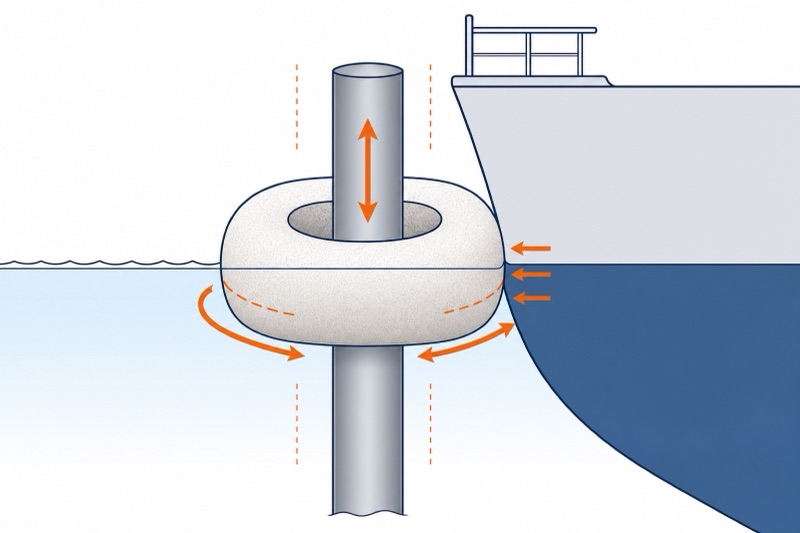
How the fender works on a pile
The fender threads over a fixed vertical monopile and floats, so it rises and falls with the tide and keeps the contact face at the waterline without anyone repositioning it. When a vessel pushes against it, the closed-cell foam core absorbs the berthing energy and spreads the reaction force, lowering the hull pressure at the contact point.
A galvanized steel sleeve lined with UHMW-PE bearing pads lets the fender rotate around the pile, so it eliminates shear as the hull moves and adjusts to the approach angle — which is why it suits dolphin steering and lead-in structures. Few other fenders handle both tidal range and approach angle without manual repositioning.
Why a donut over a fixed or suspended fender. A fixed rubber fender bolted to a wall stays put while the tide moves the contact point; a chain-suspended foam fender swings but does not turn on a pile. The donut both rises with the tide and rotates to follow the hull, so it keeps protecting through the tidal range and at any approach angle. The trade-off is that it needs a sound, coated monopile to slide and turn on.
Breasting dolphins at tidal berths
The most common use — ferry terminals, LNG jetties, and offshore supply bases where the fender must follow a large tidal range without multiple fixed levels.
Turning dolphins & lead-in
Where guiding the vessel in matters more than peak energy, the fender compresses and rotates to steer the hull and eliminate shear.
Bridge pier & monopile protection
Protecting bridge piers in navigable waters and offshore wind monopiles, where the design basis differs from routine berthing and is checked case by case.
What Sets the Size of a Donut Fender
A donut fender is not sized on energy alone. Because it rides on a pile, the size depends on the pile diameter and clearance, the tidal travel, and the pile load as well as the berthing energy and hull pressure. The table below lists the variables we work through with you; performance curves for a chosen size come from our engineering team rather than a fixed off-the-shelf chart, and the berthing energy is run on PIANC guidance.
The variable that catches people out: bore clearance. The central bore must clear the pile’s UHMW-PE liner, coating, build tolerance, and years of marine growth. Too tight and the fender jams at low tide; too loose and it tilts and wears the skin edge unevenly. As-built pile diameter often differs from the drawing by 10–20 mm, so we confirm the measured pile diameter and surface condition before sizing.
| Variable | Why it matters | What we need from you |
|---|---|---|
| Pile diameter | Sets bore size, liner clearance, and how freely it rotates | As-built outer diameter, coating thickness, marine-growth allowance |
| Fender outer diameter | Controls energy absorption and hull-to-pile standoff | Target energy absorption and minimum standoff |
| Foam density | Balances energy absorption against hull pressure | Maximum allowable hull pressure for the vessel type |
| Tidal range | Sets vertical travel and the pile length needed | LAT/HAT data, pile cap and mudline elevations |
| Berthing energy | Sets the minimum fender performance | Displacement, velocity, angle, added mass, eccentricity, single or multi-fender contact |
Energy absorption, reaction force, and hull pressure are kept distinct: foam density trades energy absorption against hull pressure, while reaction force and energy are the performance checks. We confirm the measured pile diameter and condition first, because a smooth, well-coated pile is what lets the fender keep sliding and rotating over its life.
The most common sizing mistake. Copying the foam density of a same-diameter suspended fender onto a monopile. The central bore removes compression area and oblique contact pushes the load toward the skin edge, so a density that works on a hanging fender can underperform on a pile. We size the donut as its own case, not as a hung fender with a hole.
Know your pile diameter and tidal range?
Send the as-built pile size, tidal data, and vessel — we size the donut and confirm the bore clearance.
Construction, Service Life & Maintenance
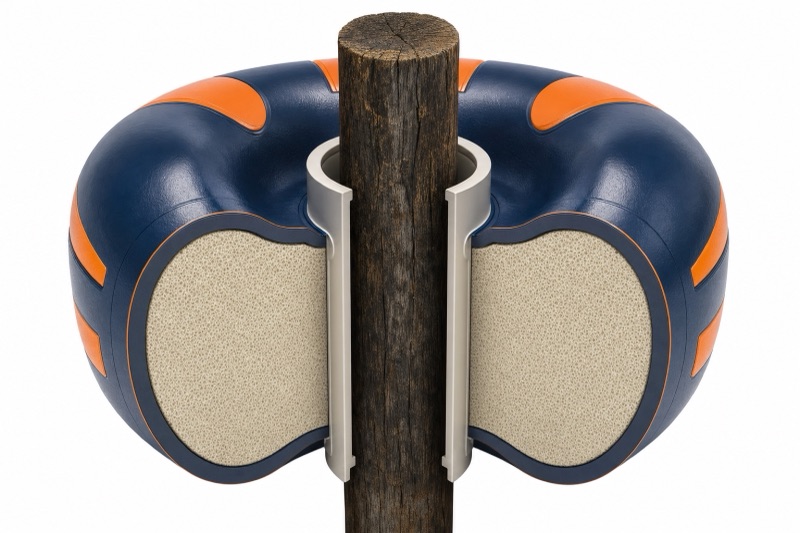
Foam core, polyurethane skin, lined steel bore
The core is 100% closed-cell, cross-linked polyethylene foam that does not sink, split, or absorb water, inside a polyurethane elastomer skin reinforced with continuous nylon filaments for abrasion and corrosion resistance. The central bore is a rigid galvanized steel sleeve lined with UHMW-PE bearing pads, which fixes the fender to the monopile and lets it rotate with low friction.
We tune foam hardness, skin thickness, diameter, and height to the berth, and add accessories where the duty calls for them — mooring crowns for holding power, counterweights for buoyancy stability underwater, and protection nets for heavy-duty service. Any accessory changes weight and buoyancy, so we re-check the waterline across the tidal range.
Service life
Typically 10 to 15 years on a smooth, well-coated pile. Heavy ferry duty, pile corrosion, marine growth, and repeated overload shorten it, so the pile condition matters as much as the fender.
Maintenance
Inspect at least every 6 months or after a major berthing. The focus is the liner, the pile coating, and marine growth; rinse off salt and clear debris from between fender and pile so it keeps rotating.
Self-buoyant & burst-resistant
The closed-cell core does not flood, so a punctured skin does not sink the fender; repair skin damage promptly to stop UV ageing from spreading.
When a Different Fender Fits Better
Donut fenders are one option in our wider foam filled fender range, built for berths on a monopile. They are not the right fender where there is no pile to ride on, so here is where something else fits better.
You have no pile to mount on
For a floating fender hung on straps or wrapped in a net rather than threaded on a pile, use the sling type or tire-chain net foam filled fender.
You need ship-to-ship or open-berth duty
For transfer between vessels or an open berth without a fixed pile, a floating pneumatic fender suits better and can be re-inflated.
You are protecting a fixed dock wall
For a fender bolted to a quay or dock face rather than riding a pile, fixed rubber fenders are the right type.
An honest boundary. A donut fender only works on a sound, coated pile: heavy marine growth, corrosion, or exposed welds can wear the liner and eventually lock it in place. Where the pile cannot be kept in good condition, or where the job is bridge-pier impact rather than routine berthing, we will say so and check the design basis separately.
Donut Fenders — Frequently Asked Questions
How does a donut fender work on a pile?
It threads over a fixed vertical monopile and floats, so it rises and falls with the tide and keeps the contact face at the waterline. A galvanized steel sleeve lined with UHMW-PE bearing pads lets it rotate around the pile, so it follows the hull, eliminates shear, and adjusts to the approach angle.
How do I size a donut fender?
From the as-built pile diameter, the tidal range, and the berthing energy — not outer diameter alone. We confirm the measured pile diameter and surface condition, set the bore clearance, balance foam density against hull pressure, and run the berthing energy on PIANC guidance.
Why does bore clearance matter so much?
The bore must clear the pile’s liner, coating, build tolerance, and years of marine growth. Too tight and it jams at low tide; too loose and it tilts and wears unevenly. As-built pile diameter often differs from the drawing by 10–20 mm, so we size to the measured pile.
Will it sink if the skin is damaged?
No. The core is closed-cell foam that does not absorb water, so a punctured or torn skin does not sink the fender. Repair skin damage promptly, since exposure speeds up UV ageing.
How long does a donut fender last?
Typically 10 to 15 years on a smooth, well-coated pile. Heavy ferry duty, pile corrosion, marine growth, and repeated overload shorten it, which is why the pile condition matters as much as the fender.
How is it different from a Yokohama pneumatic fender?
A donut fender has a foam core and fixes over a monopile; a Yokohama fender is filled with compressed air and hangs on chains for ship-to-ship transfer or open berths. The donut is for tidal monopile berths; for floating, re-inflatable duty use a pneumatic fender.
Size the donut on the pile and the tide, not just the diameter
A donut fender only works when the bore clears the pile and the foam covers the berthing energy across the tidal range. Send us the pile and the berth and we return the size and the bore clearance, worked from your measured numbers.
What to send us
6 inputsYou get back: a recommended outer diameter, bore size and clearance, foam density, and height for the tidal range, with the energy and reaction-force basis.