
Sling Type Foam Filled Fenders for STS & Berthing Protection
We manufacture sling type foam filled fenders with a closed-cell EVA foam core and a polyurethane skin, sized from Ø500 × 1000 mm to Ø3000 × 6000 mm with energy absorption from 8 to about 2,245 kJ at 60% compression. The foam core keeps the fender afloat even when the skin is punctured, so the unit is maintenance-free with no air to check, and it absorbs roughly 40% more energy than a comparable pneumatic fender at a lower reaction force. Lifting straps on both sides and no steel structure make it light to ship and quick to deploy. We have manufactured marine fenders in Qingdao since 2005, and we size every fender to your berthing energy rather than a catalogue figure.
Where Sling Type Foam Fenders Earn Their Place
Sling type foam filled fenders suit operators who need a floating fender that is maintenance-free and will not sink if the skin is damaged — provided the berthing energy and the contact face are confirmed. We use them for ship-to-ship transfer, ship-to-shore berthing, and temporary or emergency duty, and we size the diameter and length from your berthing energy rather than from the size of one fender.
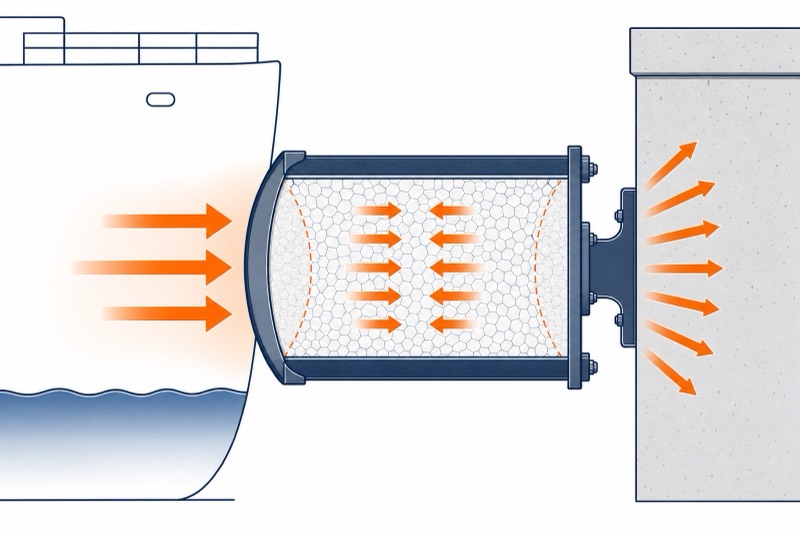
How the fender absorbs energy
The fender sits between the hull and the structure and compresses on contact. The closed-cell foam core absorbs the berthing energy and spreads the reaction force over the contact face, so the hull is not point-loaded. Because the cells are closed, the core stays buoyant and the fender keeps working even if the outer skin is punctured.
That is the core difference from a pneumatic fender, which relies on contained air: a foam core has no air to lose, so it is maintenance-free and unsinkable, and it absorbs roughly 40% more energy at a lower reaction force. The trade-off is that a foam fender is a permanent, heavier unit rather than a deflatable one, which we factor into the choice.
Why a foam core over a pneumatic fender. A closed-cell foam fender has no air to check or top up, stays afloat if punctured, and absorbs more energy at a lower reaction force, which suits exposed or unmanned berths. The trade-off is weight and that it cannot be deflated for stowage; where you need a light, packable, re-inflatable unit, a pneumatic fender fits better.
Ship-to-ship transfer (STS)
Cushioning the contact between two vessels working alongside, where a punctured fender must keep floating and protecting both hulls.
Ship-to-shore berthing
Protecting the quay and the hull during berthing against fixed structures, with energy absorbed and reaction spread over the contact face.
Temporary & emergency use
Light, no-steel construction with lifting straps deploys fast for breakdowns, repair stops, and temporary berths.
Energy Absorption & Reaction Force by Size
Foam fenders are selected on berthing energy, not on diameter alone. The table gives energy absorption (kJ) and reaction force (kN) at 60% compression for each size — energy absorption is what the fender soaks up, and reaction force is what it transmits to the structure; the two must be read together. We size against your berthing energy, typically using a PIANC calculation from vessel displacement, approach speed, and berth type.
Reading the table. Both figures are at 60% compression. Energy absorption (kJ) sets whether the fender can stop your vessel; reaction force (kN) sets the load on the quay or hull and must stay within their limits. Hull pressure (kPa) is not in this chart, so we confirm it separately against the contact area for your berth.
| Size (D × L) | D (mm) | L (mm) | Reaction force (kN) | Energy absorption (kJ) | Reference weight (kg) |
|---|---|---|---|---|---|
| Ø500 × 1000L | 500 | 1000 | 71 | 8 | 34 |
| Ø600 × 1000L | 600 | 1000 | 86 | 12 | 45 |
| Ø700 × 1500L | 700 | 1500 | 161 | 27 | 101 |
| Ø1000 × 1500L | 1000 | 1500 | 205 | 49 | 206 |
| Ø1000 × 2000L | 1000 | 2000 | 274 | 64 | 275 |
| Ø1200 × 2000L | 1200 | 2000 | 337 | 93 | 405 |
| Ø1200 × 2400L | 1200 | 2400 | 390 | 110 | 475 |
| Ø1350 × 2500L | 1350 | 2500 | 463 | 145 | 626 |
| Ø1500 × 3000L | 1500 | 3000 | 624 | 216 | 927 |
| Ø1700 × 3000L | 1700 | 3000 | 696 | 273 | 1191 |
| Ø2000 × 3500L | 2000 | 3500 | 990 | 456 | 1923 |
| Ø2000 × 4000L | 2000 | 4000 | 1110 | 505 | 2298 |
| Ø2200 × 4500L | 2200 | 4500 | 1396 | 679 | 2992 |
| Ø2500 × 4000L | 2500 | 4000 | 1386 | 781 | 3434 |
| Ø2500 × 5000L | 2500 | 5000 | 1750 | 985 | 4272 |
| Ø3000 × 5000L | 3000 | 5000 | 2050 | 1410 | 6411 |
| Ø3000 × 6000L | 3000 | 6000 | 2460 | 1695 | 7293 |
| Ø3300 × 6500L | 3300 | 6500 | 2950 | 2245 | 8335 |
| Ø4500 × 9000L | 4500 | 9000 | 19650* | 7860* | 21460* |
Reaction force and energy absorption are at 60% compression; reaction force is the load passed to the structure, energy absorption is what the fender soaks up. The last row (Ø4500 × 9000L, marked *) is out of trend — its reaction force of 19,650 kN and energy of 7,860 kJ break the progression from the Ø3300 row (2,950 kN / 2,245 kJ) and look like a transcription error in the source chart, so we confirm that row with the factory before quoting it. Hull pressure is not listed and is confirmed separately for your contact face.
The most common sizing mistake. Picking a fender on diameter or energy alone and ignoring reaction force and hull pressure. A larger fender that absorbs the energy can still pass too much reaction force into an old quay, or too high a hull pressure into a thin shell. We balance energy absorption, reaction force, and hull pressure together against your berth.
Know your vessel size and berth?
Send displacement, approach speed, and berth type — we run the berthing energy and size the fender.
Construction, Service Life & Maintenance
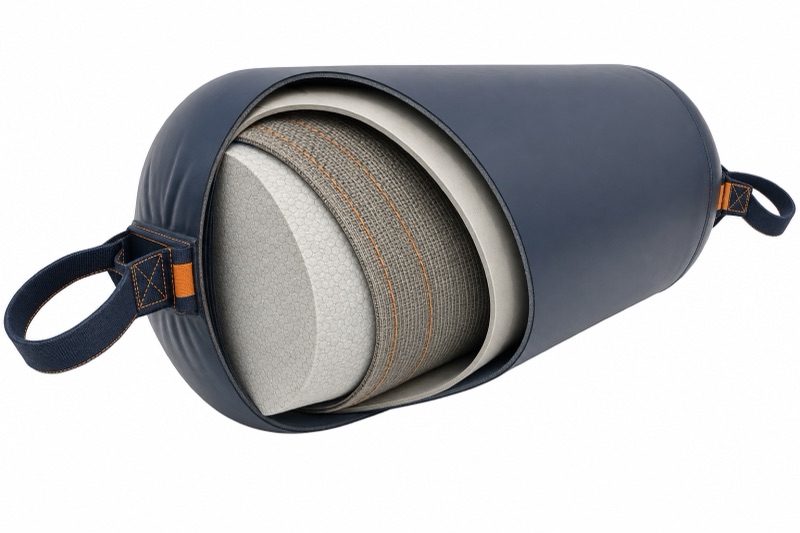
Closed-cell foam core, polyurethane skin
The core is closed-cell EVA foam in a choice of densities, sealed inside nylon-cord fabric reinforcement and a thermally laminated polyurethane elastomer skin that resists abrasion and tearing. Because the sling type carries no steel structure, it is light to ship and quick to install, with high-strength lifting straps on both sides rather than a chain-and-tire net.
The closed-cell core is what makes the fender unsinkable: punctures do not flood it, so it keeps its buoyancy and energy absorption. The skin can be finished in a choice of colours, and we select the foam density to match your energy and reaction targets.
Service life
Typically 15 to 20 years depending on exposure and duty, with the polyurethane skin resisting seawater, UV, and ageing. We confirm your service conditions so the skin grade and foam density match.
Maintenance
Maintenance-free with no air to check or top up — unlike a pneumatic fender. An annual visual check of the skin and straps for damage is all that is needed.
Storage & shipping
Light, no-steel build with lifting straps makes transport and redeployment easy; store away from sharp objects and secure the anchoring to suit the site.
When a Different Fender Fits Better
Sling type foam fenders are one option in our wider foam filled fender range, and they are not the right fender for every berth. We would rather route you to the correct product than oversell these, so here is where something else fits better.
You need a heavier-duty net mount
For permanent, high-abrasion installations that need a more rugged casing, the tire-chain net foam filled fender uses a chain-and-tire net instead of lifting straps.
You want a light, packable unit
For temporary STS work where you need to deflate and stow the fender between jobs, a floating pneumatic fender is lighter to handle and re-inflatable.
You are protecting a fixed dock wall
For a permanently mounted fender on a quay or dock face rather than a floating unit, fixed rubber fenders suit better.
An honest boundary. A foam fender is a permanent, heavier unit; it cannot be deflated for compact stowage, and a very large size carries real weight to handle. Where you need a light, re-inflatable fender or a hull pressure below what the contact face allows, we will say so and recommend the fitting alternative.
Sling Type Foam Filled Fenders — Frequently Asked Questions
What is the difference between sling type and tire-chain net foam fenders?
They differ by the casing and mounting: the sling type uses high-strength lifting straps on both sides and no steel structure, so it is lighter and quicker to deploy, while the tire-chain net type wraps the fender in a chain-and-tire net for heavier, more abrasive permanent service.
Why is a foam filled fender maintenance-free and unsinkable?
The core is closed-cell foam, so there is no contained air to check or top up, and a puncture does not flood the core. The fender keeps its buoyancy and energy absorption even when the skin is damaged, which is why it is treated as maintenance-free and unsinkable.
How much energy does it absorb compared with a pneumatic fender?
A foam filled fender absorbs roughly 40% more energy than a comparable pneumatic fender at a lower reaction force. We confirm the exact figures from the size table at 60% compression and size against your berthing energy.
How do I choose the right size?
By berthing energy, not diameter. We typically run a PIANC calculation from vessel displacement, approach speed, and berth type, then pick a size whose energy absorption covers it while keeping reaction force and hull pressure within the structure’s and hull’s limits.
What standard are they designed to?
They are designed to ISO 17357, the standard for floating fenders, and sized against PIANC berthing-energy guidance. We confirm which certifications apply to your scope on request rather than publishing a fixed certificate list.
How long do they last?
Typically 15 to 20 years depending on exposure and duty, with the polyurethane skin resisting seawater, UV, and ageing. An annual visual inspection of the skin and straps is the only routine check.
Size the fender on berthing energy, not diameter
A fender is only right when its energy absorption covers your berthing energy while reaction force and hull pressure stay within limits. Send us the berth and vessel and we return the size, worked from your numbers rather than a catalogue row.
What to send us
6 inputsYou get back: a recommended diameter and length with energy absorption and reaction force at 60% compression, and the foam density and skin grade for your service.