
Tire Chain Net Foam Filled Fenders for Permanent, High-Abrasion Berths
We manufacture tire chain net foam filled fenders in three layers: a closed-cell foam core, an outer tire-chain net casing, and a polyurethane skin, sized from Ø500 × 1000 mm to Ø3000 × 6000 mm with energy absorption from 8 to about 2,245 kJ at 60% compression. The net wraps used tires interwoven with high-strength metal chains around the fender, which is what gives it the abrasion resistance for permanent, high-traffic, harsh-condition berths. The closed-cell core keeps the fender afloat even when punctured, there is no air to check, and damaged net or tire sections can be replaced one at a time. We have manufactured marine fenders in Qingdao since 2005, and we size every fender to your berthing energy rather than a catalogue figure.
Where Tire Chain Net Foam Fenders Earn Their Place
Tire chain net foam fenders suit permanent berths that see heavy, repeated contact and need an abrasion-resistant casing — provided the berthing energy and the contact face are confirmed. We use them at busy ports where many vessels of different tonnage berth daily, and in harsh climates from tropical heat and UV to sub-zero cold, sizing the diameter and length from your berthing energy rather than from the size of one fender.
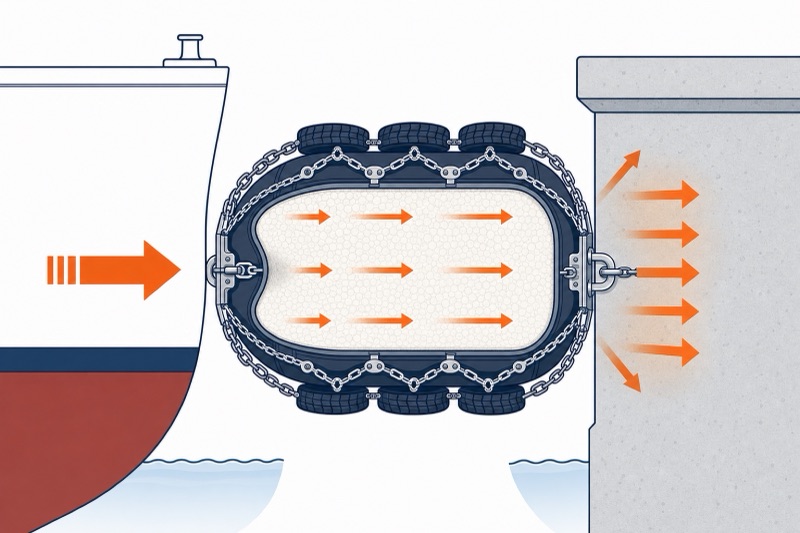
How the fender absorbs energy
The fender compresses on contact, and the closed-cell foam core absorbs the berthing energy and spreads the reaction force over the contact face. Because the cells are closed, the core stays buoyant and keeps working even if the skin is punctured, so the fender does not sink.
The tire-chain net adds a second job on top of energy absorption: the tires flex and cushion while the high-strength metal chains hold the net stable, so the casing resists the friction and crushing of repeated berthing and protects the polyurethane skin. That abrasion resistance is what makes this type suited to permanent, high-traffic installations rather than quick temporary use.
Why a chain-tire net over lifting straps. The net casing takes the abrasion of permanent, high-traffic berths and lets damaged tire or chain sections be replaced one at a time, so the fender stays in service longer in harsh conditions. The trade-off is added weight and a fixed installation; for temporary, ship-to-ship, or quick-reposition work, the lighter sling type foam filled fender fits better.
High-traffic ports
Busy berths where many vessels of different tonnage contact the fender daily, demanding an abrasion-resistant, repairable casing.
Harsh & extreme climates
From tropical heat, humidity, and UV to sub-zero cold and frequent freeze-thaw, where the net resists ageing and wear.
Permanent installations
Fixed, long-service berths where a rugged, modular casing is worth more than the light weight of a temporary unit.
Energy Absorption & Reaction Force by Size
The foam body shares the size range and performance of our foam filled fender line, selected on berthing energy rather than diameter alone. The table gives energy absorption (kJ) and reaction force (kN) at 60% compression for each size — energy absorption is what the fender soaks up, and reaction force is what it passes to the structure; the two are read together. We size against your berthing energy, typically using a PIANC calculation from vessel displacement, approach speed, and berth type.
Reading the table. Both figures are at 60% compression. Energy absorption (kJ) sets whether the fender can stop your vessel; reaction force (kN) sets the load on the quay or hull. The table is the foam-body chart; the tire-chain net adds protective weight that we confirm per size, and hull pressure (kPa) is confirmed separately against your contact area.
| Size (D × L) | D (mm) | L (mm) | Reaction force (kN) | Energy absorption (kJ) | Reference weight (kg) |
|---|---|---|---|---|---|
| Ø500 × 1000L | 500 | 1000 | 71 | 8 | 34 |
| Ø600 × 1000L | 600 | 1000 | 86 | 12 | 45 |
| Ø700 × 1500L | 700 | 1500 | 161 | 27 | 101 |
| Ø1000 × 1500L | 1000 | 1500 | 205 | 49 | 206 |
| Ø1000 × 2000L | 1000 | 2000 | 274 | 64 | 275 |
| Ø1200 × 2000L | 1200 | 2000 | 337 | 93 | 405 |
| Ø1200 × 2400L | 1200 | 2400 | 390 | 110 | 475 |
| Ø1350 × 2500L | 1350 | 2500 | 463 | 145 | 626 |
| Ø1500 × 3000L | 1500 | 3000 | 624 | 216 | 927 |
| Ø1700 × 3000L | 1700 | 3000 | 696 | 273 | 1191 |
| Ø2000 × 3500L | 2000 | 3500 | 990 | 456 | 1923 |
| Ø2000 × 4000L | 2000 | 4000 | 1110 | 505 | 2298 |
| Ø2200 × 4500L | 2200 | 4500 | 1396 | 679 | 2992 |
| Ø2500 × 4000L | 2500 | 4000 | 1386 | 781 | 3434 |
| Ø2500 × 5000L | 2500 | 5000 | 1750 | 985 | 4272 |
| Ø3000 × 5000L | 3000 | 5000 | 2050 | 1410 | 6411 |
| Ø3000 × 6000L | 3000 | 6000 | 2460 | 1695 | 7293 |
| Ø3300 × 6500L | 3300 | 6500 | 2950 | 2245 | 8335 |
| Ø4500 × 9000L | 4500 | 9000 | 19650* | 7860* | 21460* |
Reaction force and energy absorption are the foam body’s values at 60% compression; the tire-chain net adds protective weight on top of the reference weight, confirmed per size. The last row (Ø4500 × 9000L, marked *) is out of trend — its 19,650 kN and 7,860 kJ break the progression from the Ø3300 row (2,950 kN / 2,245 kJ) and look like a transcription error in the source chart, so we confirm that row with the factory before quoting it. Hull pressure is confirmed separately for your contact face.
The most common sizing mistake. Choosing the net casing for abrasion but sizing the foam body on diameter alone. Energy absorption must cover your berthing energy while reaction force and hull pressure stay within the quay’s and hull’s limits — the net protects the fender, but it does not change the berthing-energy calculation.
Know your vessel size and berth?
Send displacement, approach speed, and berth type — we run the berthing energy and size the fender.
Three-Layer Construction & Maintenance
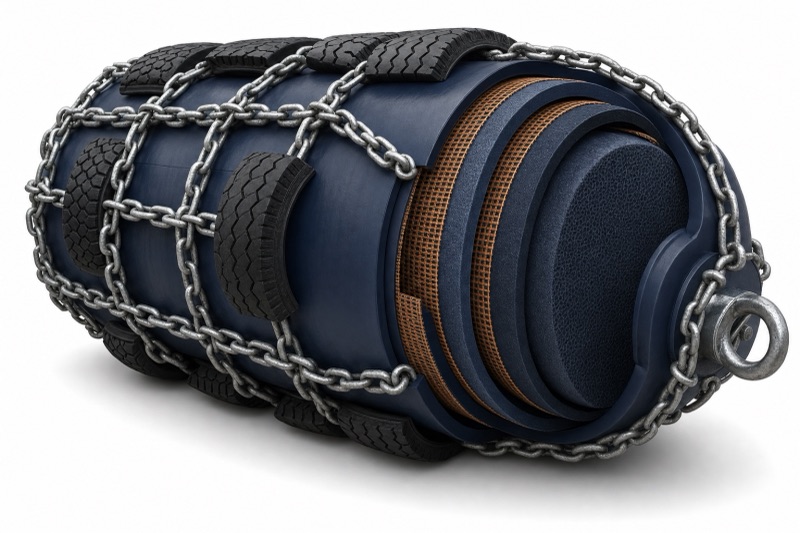
Foam core, polyurethane skin, tire-chain net
The fender is built in three layers: a closed-cell foam core for buoyancy and energy absorption, a polyurethane skin sealing the core, and an outer net that interweaves used tires with high-strength metal chains. The tires flex to cushion contact while the chains hold the net stable, so the casing spreads load and resists abrasion.
The net is built for repair: damaged tire or chain sections can be replaced one at a time rather than scrapping the fender, which keeps a permanent installation in service. Using waste tires for the net also puts an end-of-life material back to work.
Durability & abrasion
The tire-chain net resists the friction, crushing, and impact of daily berthing and adapts to extreme climates, protecting the foam body and extending service.
Maintenance
No inflation to check, unlike a pneumatic fender, and the net’s modular design lets damaged tire or chain sections be swapped without replacing the whole fender.
Environmental
The net is made from waste tires, recycling an end-of-life material into the protective casing.
When a Different Fender Fits Better
Tire chain net foam fenders are one option in our wider foam filled fender range, built for permanent, high-abrasion berths. They are not the right fender for light, temporary, or quick-reposition work, so here is where something else fits better.
You need a light, quick-move unit
For temporary berthing, ship-to-ship transfer, and quick repositioning, the lighter sling type foam filled fender hangs on lifting straps and is faster to handle.
You want a packable, re-inflatable fender
For STS work where you deflate and stow the fender between jobs, a floating pneumatic fender is lighter and re-inflatable.
You are protecting a fixed dock wall
For a permanently mounted fender on a quay or dock face rather than a floating unit, fixed rubber fenders suit better.
An honest boundary. The net casing adds weight and is built for fixed, permanent service; it is not the fender to lift in and out daily or stow compactly. Where you need a light, deflatable, or quickly repositioned fender, we will say so and point you to the alternative rather than oversell the net.
Tire Chain Net Foam Filled Fenders — Frequently Asked Questions
What does the tire-chain net layer do?
It wraps the fender in used tires interwoven with high-strength metal chains. The tires flex to cushion contact while the chains hold the net stable, so the casing spreads load and resists the abrasion of repeated berthing, protecting the polyurethane skin and foam core.
How do I choose between the tire-chain net and sling type?
Choose the tire-chain net for permanent installations, high-traffic ports, and harsh conditions where abrasion resistance matters. Choose the sling type for temporary berthing, ship-to-ship transfer, and quick repositioning, where lighter weight and fast handling matter more.
What are the chains and tires made of?
The chains are high-strength metal and the net uses recycled waste tires. We confirm the exact chain grade and tire specification for your order rather than state a figure the product data does not fix.
Is the fender still usable if the skin is punctured?
Yes. The core is closed-cell foam, so a puncture does not flood it; the fender keeps its buoyancy and energy absorption and does not sink. The net and skin can then be repaired in sections.
Does it need inflation or much maintenance?
No inflation is needed, unlike a pneumatic fender, so there is no air pressure to monitor. The net is modular, so damaged tire or chain sections can be replaced one at a time instead of scrapping the whole fender.
What standard are they designed to?
The foam body is designed to ISO 17357, the standard for floating fenders, and sized against PIANC berthing-energy guidance. We confirm which certifications apply to your scope on request rather than publishing a fixed certificate list.
Size the fender on berthing energy, not the net
The tire-chain net protects the fender, but the size still follows berthing energy, reaction force, and hull pressure. Send us the berth and vessel and we return the size, worked from your numbers rather than a catalogue row.
What to send us
6 inputsYou get back: a recommended diameter and length with energy absorption and reaction force at 60% compression, plus the net specification for your service.