
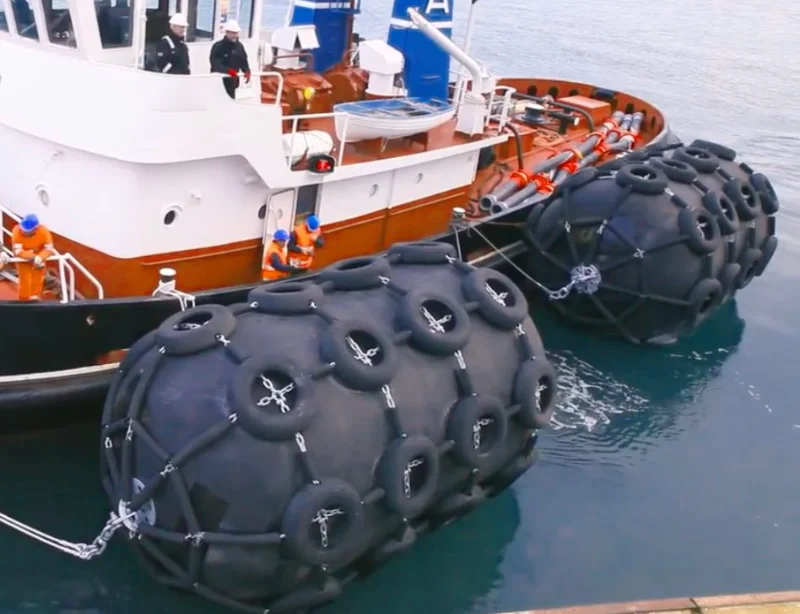
Types of pneumatic fenders divide along two lines that do not agree. ISO 17357-1:2014 classifies three configurations: Type I net, Type I Single net and Type II sling. Catalogue names multiply those three into a dozen codes covering colour, tyre source and harness detail. Initial internal pressure, 50 kPa or 80 kPa, is a separate axis cutting across all three. Hydro-pneumatic units are ballasted with water to sit below the waterline, and are not among the classified types at all. Which line governs a purchase depends on the hull, the berth, and what the enquiry states.
The Three Types of Pneumatic Fenders Classified in ISO 17357-1:2014
ISO 17357-1:2014 sorts high-pressure floating pneumatic rubber fenders into three configurations, and what separates them is the external protection plus how the ends of the body are built. Part 1 covers the material, performance and dimensions of these fenders for berthing and mooring one ship to another or to a berthing structure. It also covers the test and inspection procedures that verify them.
Clause 4.1 lists three. Type I is a net type. Type I Single is a net type whose second end carries no flange opening and no metal parts. Type II is the sling type.
All three share one body requirement: a cylindrical air bag with hemispherical heads, built from outer rubber, synthetic-tyre-cord reinforcement layers and inner rubber, vulcanised firmly together. End construction is where they part. Net types carry a chain, wire or fibre net, with the longitudinal members linked at each end by rings that take a guy chain or guy rope. Used tyres or rubber sleeves are usually fitted over that net. Sling pneumatic fenders carry a lifting device at each end instead.
Two end details follow from the type. Bead-ring and cord turn-up construction at the flange opening can be excluded on Type I fenders. Type I Single moves the flange to one end only, leaving the opposite end with no metal to deform under heavy compression.
Initial internal pressure is a separate axis. Clause 4.2 defines two grades, pneumatic 50 and pneumatic 80, and each exists in net and sling form. The grade a berth can accept follows from the reaction force and hull pressure the vessel and structure will tolerate at the guaranteed energy absorption deflection.
Type selection does not size a fender. Diameter and length come from a berthing energy calculation for the specific vessel and berth, a separate exercise from the classification covered here.
Why Catalogue Type Codes Do Not Match the Standard’s Classification
Catalogue type codes sit on top of the three configurations ISO 17357-1 classifies, and whether one marks a different class or only a different finish depends on what the code encodes. Harness material, tyre source and rubber colour are all encoded this way. Chain-tyre-net, aircraft-tyre chain net, rubber-sleeve chain net, grey body with grey harness, sling grey body. Each resolves to Type I, Type I Single or Type II, plus a finish choice. The first is usually abbreviated CTN, and written chain-tire-net in commercial literature.
The effect shows up when quotes come back. Two suppliers answering one enquiry with different codes may be offering the same classified type at different pressure grades, or different types at the same grade. The code alone will not separate them. Colour is the plainest example of what a code leaves open: the standard treats it as an ordering item, and defaults it to black when the enquiry says nothing.
Where an enquiry names only a catalogue code and a length, units can arrive matching that code exactly and still miss the reaction force the quay was designed around. The code carries no pressure grade. The check at that point runs against the berthing energy figure, not against the net.
What a Protection Net Changes on a Pneumatic Fender, and What It Does Not
A protection net sits outside the fender’s gas envelope, so it changes abrasion exposure, contact geometry and handling mass rather than the rated performance figures, which follow from size and pressure grade. The premises sit in the standard. Performance is specified as guaranteed energy absorption, reaction force at the GEA deflection and hull pressure at that deflection. GEA values come from the tables for pneumatic 50 and pneumatic 80, read at 60 plus or minus 5 per cent deflection. The net is defined as a covering placed over a body whose construction requirement is common to all three types.
At equal diameter, length and pressure grade, a net therefore does not raise a fender’s certified GEA or lower its certified reaction force. It holds no air, and it does not alter the pressure-volume relationship inside the body. Where a catalogue table shows net types absorbing more energy than sling types, it is comparing different size ranges. A specification asking for a net type in order to gain energy is reaching for the wrong variable. At fixed size, higher energy comes from the higher pressure grade, and that grade raises hull pressure at the same time.
What the net does change is the surface presented to the hull, the standoff it holds, the mass to be lifted, and the abrasion and puncture loading reaching the body. A non-marking requirement rules out conventional black used-tyre and exposed-chain arrangements unless a non-marking harness is specified. It does not rule out net types as such. Grey non-marking harness and sleeve configurations are offered for exactly this case.
On berths where a fender stays deployed and works in a swell, the net hardware is often what needs re-inspection before anything on the body: connecting rings, shackles, tyre lashings.
Where Hydro-Pneumatic Fenders Sit Relative to the Standard
Hydro-pneumatic fenders are ballasted with water so they hang below the waterline, which puts them outside the three types classified for high-pressure floating fenders, even though the market lists them beside net and sling types. Part 1 defines its subject as a fender at 50 or 80 kPa able to float on the water. Part 2 covers low-pressure floating fenders. A unit designed to sit submerged is named in neither.
Water filling itself is not foreign to the standard. Clause 6.1.5 provides for the flange opening to serve both air charging and water filling. What stops at the waterline is the classification and the performance framework around it. A submerged unit’s water-to-air ratio, working draught and counterweight arrangement are not parameterised by the size tables, and its performance curve cannot be read from them.
Contracts commonly bridge that gap. They apply the standard’s material, construction, pressure and test requirements to the fender body, then write project-specific acceptance criteria for what the tables do not reach. What those criteria must fix depends on the draught range at the contact point, the hull pressure the hull treatment will take, and the fill ratio to be held in service.
Which Pneumatic Fender Variables Close at Manufacture, and Which Stay Open
Fender variables close at three different points, manufacture, order and commissioning, and the ones closing first deserve confirming first, because no later decision can revise them. The body is vulcanised once, and that build carries the pressure grade, the cord layers holding it, the outer rubber compound and colour, and the flange and bead-ring arrangement.
| Variable group | Where it closes | Examples | Revisable afterwards |
|---|---|---|---|
| Body and its certified rating | Manufacture | Diameter and length; pressure grade; cord construction; outer rubber compound and colour; flange, bead ring, and the metal-free end of Type I Single | No |
| Operating pressure | Commissioning and service | Initial internal pressure, set and checked through the air valve every fender is required to carry | Yes, routinely |
| External protection | Order, then service | Net material (chain, wire, fibre); tyre or rubber-sleeve covering; guy chain or guy rope | Yes, replaceable |
| Documentation and fittings | Order | Identification system; safety valve on units under 2 500 mm; classification society inspection; prototype and commercial test certificates | Partly |
The order of work follows from that split, not from any preference about type. Confirm the hull constraint first: the permissible hull pressure, and whether the hull treatment requires a non-marking body. Then confirm the pressure grade. Both are written into a build that cannot be revised.
Net versus sling, tyre source, marking and witnessed testing can follow, since the net is a replaceable assembly and the rest are order-stage lines. One caution on sequence. Retrofitting a net onto a unit built as a sling type is a supplier question, not a yard one, because net loads run into end fittings vulcanised into the body.
Where one vessel class berths at a fixed quay under a small tidal range and the fender never has to move, a fixed rubber fender system may well cost less across its service life. That comparison turns on civil works, installation access, replacement strategy and vessel mix. The pneumatic category earns its cost where the draught changes, the vessel pairing changes, or the fender has to be repositioned.
Where to Start With a Pneumatic Fender Type Decision
Types of pneumatic fenders are easiest to settle from the outside in. Fix what the hull and the berth will not tolerate, then fix the pressure grade, and treat net versus sling as the later, reversible question it is. Type decisions that get reopened late are usually ones where the grade was left to the supplier while the type name was pinned down early. That is the wrong order for a body vulcanised once. How much of this can close before an enquiry goes out depends on whether the design berthing energy for the vessel pairing has been calculated.
Before we quote a pneumatic rubber fender, we align the classified type, the pressure grade and the size against the buyer’s berthing energy figure, and we flag a mismatch instead of quoting around it.
Clause 5.1 puts part of the specification on the buyer, and it reads better as a working checklist than as boilerplate. It recommends that a purchase order or enquiry state:
- the standard number with its applicable year and part
- nominal diameter and length from the size tables, or a non-tabulated size satisfying the standard’s own dimensional requirement
- the fender type per clause 4.1, including whether Type I Single is wanted
- the initial internal pressure, pneumatic 50 or pneumatic 80
- the fender colour, which defaults to black if the enquiry is silent
- whether a safety valve is required on units below 2 500 mm in diameter
- whether an identification system is required
- whether inspection or evaluation by a major classification society is required
FAQ
Is a “Yokohama fender” a separate type?
No. Yokohama fender is a trade term, not a class in clause 4.1. An enquiry reading “Yokohama fender, 2.5 m” gives a trade name and one ambiguous dimension, where a size designation needs both nominal diameter and nominal length. Type, pressure grade and colour all stay open, and suppliers fill them with their own defaults.
Do smaller pneumatic fenders need a safety valve?
Only if the enquiry asks for one. Clause 6.1.7 requires a safety valve on fenders of 2 500 mm diameter and larger, to release excess pressure if a unit is over-compressed. Below that diameter the valve is optional, so a sub-2 500 mm fender ordered without the request arrives without it.
Does a supplier’s test certificate for one fender cover the size being bought?
Not automatically. Clause 5.2 lets a purchaser request a commercial fender inspection and test certificate. It has to come from a fender at least as large as the one enquired about, at the same or higher internal pressure, evaluated by a major classification society, and dated within ten years. A certificate from a smaller unit does not cover the enquiry.
Does the tyre source in a net matter?
Tyre source changes standoff and net mass, not rated performance; aircraft tyres are the heavier option some suppliers offer for greater standoff.
A tender just says “ISO 17357”. Which part applies?
Neither, on its own. The 2002 edition that number once pointed to was cancelled and replaced by Parts 1 and 2, so an undated reference leaves the pressure class open. Confirm the part and the year before anyone prices it.