
Marine Salvage Airbags for Wreck Refloating & Underwater Lifting
We manufacture closed cylindrical salvage buoyancy airbags that lift sunken and stranded objects by displacing water, with rated buoyancy from 1 to 200 t per bag, a maximum working pressure of 0.25 MPa, and service to water depths of about 25 m. Built from 6 to 12 synthetic reinforcement plies inside a heavy rubber cover, each bag carries automatic pressure-relief valves and polyester slings and is sized to a safety factor of at least 6:1. We have manufactured marine airbags in Qingdao since 2005, and we calculate the type and quantity from your submerged load rather than the buoyancy of one bag.
Where Marine Salvage Airbags Earn Their Place
Marine salvage airbags suit contractors refloating wrecks, raising underwater objects, or supporting offshore works where a fixed crane or pontoon cannot reach — provided you can confirm the submerged weight, the water depth, and how the load is rigged. We use them across wreck salvage, pontoon and pipeline work, and emergency response, and we size the type and quantity from the load case rather than the buoyancy of a single bag.
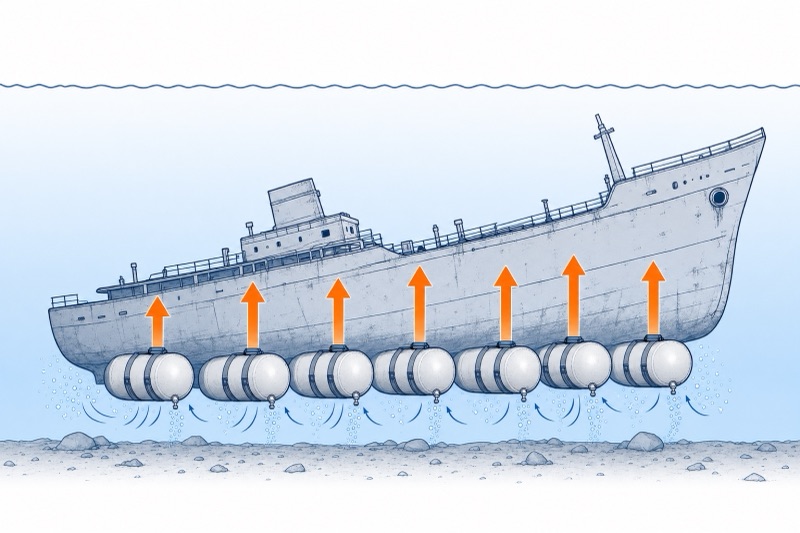
How the lift actually works
A salvage airbag works on Archimedes’ principle: compressed air inflates the bag underwater, displaces a volume of water, and generates upward buoyancy that raises the sunken object. Because buoyancy is shared across several bags rigged around the load, the lift stays balanced and the hull is not point-loaded.
We keep the lift controlled — typically around 1 m per minute — so pressure stays balanced as the bags rise. Automatic relief valves at each end vent excess pressure in deep water, which is what prevents a bag from bursting as ambient pressure changes during the ascent.
Why buoyancy bags over a fixed crane or pontoon. Bags deploy underwater, follow the load down, and spread lift across multiple attachment points, so you avoid the reach limits and point loads of a crane lift. The trade-off is that they need sound rigging and a confirmed water depth within their working range; we verify both before recommending a set.
Wreck salvage & refloating
Raising sunken or stranded vessels and clearing wreckage, including righting a wreck in deep water or floating it as a temporary pontoon in shallow water.
Underwater construction support
Pontoon and jetty construction, pipeline laying, temporary bridge support, and supporting underwater construction and repair.
Emergency & draft reduction
Emergency response after accidents, stabilising vessels, and reducing draft for deep-water platform and transit operations.
Buoyancy by Effective Length & Diameter
Buoyancy is the weight of water a bag displaces, so it rises with both effective length and diameter. The table below gives theoretical buoyancy in tonnes for each effective length across five standard diameters; the total lift is then shared across the bags rigged under the load and applied with a safety factor of at least 6:1. We confirm the working depth and lift plan your job runs at before we quote a set.
Reading the table. Columns Ø1 to Ø5 are five standard airbag diameters, smallest to largest — buoyancy rises left to right. The source data we work from listed the buoyancy steps without printing each diameter value, so we confirm the exact diameter for each column with the factory for your order rather than assume it. Overall buoyancy ranges from 1 t to 200 t per bag across the full size range.
| Effective length (m) | Ø1 buoyancy (t) | Ø2 buoyancy (t) | Ø3 buoyancy (t) | Ø4 buoyancy (t) | Ø5 buoyancy (t) |
|---|---|---|---|---|---|
| 5 | 3.93 | 5.65 | 8.84 | 12.72 | 15.71 |
| 6 | 4.71 | 6.79 | 10.6 | 15.27 | 18.85 |
| 7 | 5.5 | 7.92 | 12.37 | 17.81 | 21.99 |
| 8 | 6.28 | 9.05 | 14.14 | 20.36 | 25.13 |
| 9 | 7.07 | 10.18 | 15.9 | 22.9 | 28.27 |
| 10 | 7.85 | 11.31 | 17.67 | 25.45 | 31.42 |
| 11 | 8.64 | 12.44 | 19.44 | 27.99 | 34.56 |
| 12 | 9.42 | 13.57 | 21.21 | 30.54 | 37.7 |
| 13 | 10.21 | 14.7 | 22.97 | 33.08 | 40.84 |
| 14 | 11 | 15.83 | 24.74 | 35.63 | 43.98 |
| 15 | 11.78 | 16.96 | 26.51 | 38.17 | 47.12 |
| 16 | 12.57 | 18.1 | 28.27 | 40.72 | 50.27 |
| 17 | 13.35 | 19.23 | 30.04 | 43.26 | 53.41 |
| 18 | 14.14 | 20.36 | 31.81 | 45.8 | 56.55 |
Values are theoretical buoyancy at full displacement; usable lift is applied with a safety factor of at least 6:1 and shared across the bags in contact. Larger diameters and effective lengths reach the upper end of the 1–200 t range. Diameter labels (Ø1–Ø5) are confirmed per order: the source table listed buoyancy by column without printing each diameter, so we verify the exact diameter for each column with the factory rather than state a value we cannot source.
The most common sizing mistake. Sizing on raw buoyancy without the safety factor, or assuming one big bag will do the lift. A submerged wreck must be lifted evenly across several rigged bags, and buoyancy must be derated to at least 6:1; we plan the rig and the number of bags, not just a single buoyancy figure.
Know the submerged weight and water depth?
Send them over and we calculate the airbag diameter, effective length, and quantity for your lift.
Construction, Maintenance & What Affects Service Life
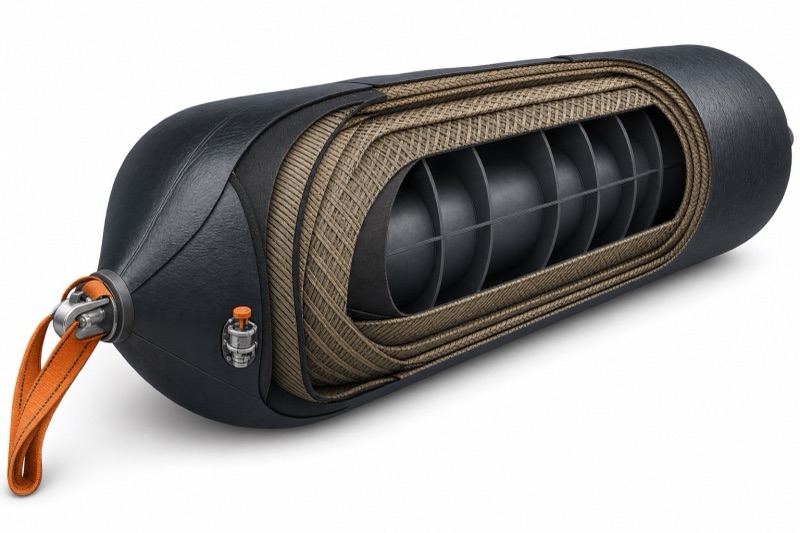
Closed cylindrical, no welded seams
Each bag is a closed cylinder: a heavy outer rubber cover 12 mm or more thick over 6 to 12 synthetic tire-cord plies, a vulcanized airtight inner layer, and internal baffles with end fittings that hold the shape and take the rigging. The integral screw-type strapping has no welded seams, and the conical ends suit complex underwater work.
Automatic pressure-relief valves and polyester slings come fitted. The material runs around 1.8 kg/m², so a 1.5 m × 10 m six-ply bag carries roughly 17 t at about 400 kg self-weight — we confirm the exact specification against your duty cycle rather than a single example.
Service life
Depends on duty cycle, water and storage conditions, and rigging discipline. We confirm how often and how deep you work so the ply count we recommend matches the service, not just one lift.
Maintenance
Rinse off salt and grit after each use, dry fully, and apply vulcanizing powder evenly. Inspect rubber, seams, and fittings before every job and repair damage immediately.
Storage & shipping
Store cool, dry, and out of direct sun, away from sharp objects; keeping bags inflated or under low pressure avoids creases that weaken the material.
Not sure how many bags your wreck needs?
Tell us the weight, depth, and rigging points — we plan the set and the lift before you commit.
When a Different Product Fits Better
Marine salvage airbags are one product in our wider marine airbags range, built for buoyancy lifting in water. They are not the right tool for dry-land lifting or for berth protection, so here is where something else fits better.
You are lifting on dry land
For lifting, jacking, or moving heavy structures on the ground rather than in water, use heavy lifting airbags, which work by direct load support, not buoyancy.
You are launching or hauling out
For rolling a vessel down a slipway to launch or haul out, use purpose-built ship launching airbags.
You need berth protection
For fendering a vessel against a structure, use floating pneumatic fenders or fixed-dock rubber fenders — salvage airbags are not fenders.
An honest boundary. Buoyancy lifting needs sound rigging, a confirmed water depth within working range, and a load that can be raised evenly. Where the rigging points are unsound or the depth exceeds the working range, we will say so and plan a staged or alternative method rather than push bags that cannot lift safely.
Marine Salvage Airbags — Frequently Asked Questions
How many salvage airbags do I need?
The number follows the submerged weight, the buoyancy of each bag, and a safety factor of at least 6:1 — not the buoyancy of one bag alone. Send us the submerged weight, water depth, and how the load can be rigged, and we calculate the diameter, effective length, and quantity.
How does a salvage airbag lift a sunken object?
By Archimedes’ principle: compressed air inflates the bag underwater and displaces water, creating upward buoyancy. We keep the lift controlled at around 1 m per minute so pressure stays balanced, and the load is shared across several rigged bags.
What working depth and pressure do they handle?
They serve water depths to about 25 m at a maximum working pressure of 0.25 MPa. Automatic relief valves at each end vent excess pressure as ambient pressure changes during the ascent, which prevents the bag from bursting in deep water.
How do I read the buoyancy table?
Buoyancy rises with both effective length (the rows) and diameter (columns Ø1 to Ø5, smallest to largest). The source data listed buoyancy by column without printing each diameter, so we confirm the exact diameter for each column with the factory for your order.
What safety factor do you size to?
At least 6:1 on buoyancy. The table values are theoretical buoyancy at full displacement; usable lift is derated to the safety factor and shared across the bags rigged under the load.
Are salvage airbags the same as ship launching airbags?
They share the same closed cylindrical design, but the job differs: salvage airbags lift by buoyancy in water, while ship launching airbags roll a vessel down a slipway. For launch and haul-out we supply purpose-built ship launching airbags.
Plan the lift on the load and the depth, not one bag
Buoyancy only means something against the submerged weight, the water depth, and a safety factor. Send us the load case and we return the diameter, effective length, and quantity worked from your numbers — with the rig planned, not a single buoyancy figure.
What to send us
6 inputsYou get back: a recommended diameter, effective length, and quantity, with the buoyancy and safety-factor basis for the lift.