
Ship Launching Airbags for Launch, Haul-Out & Heavy Transport
We manufacture ship launching airbags — cylindrical, synthetic-tire-cord-reinforced rubber rollers — for launching, hauling out, and moving vessels and heavy structures without a fixed slipway or dry dock. We size and specify each set around your vessel’s total launch weight, the ground slope, and the number of airbags in contact at the critical point of the launch, not from diameter alone. This page sets out the airbag types we supply, what determines how many you need, and where airbag launching is not the right method.
Where Ship Launching Airbags Are Used
We supply ship launching airbags for shipyards and salvage operators launching or landing cargo vessels, barges, tankers, and tugboats, and for moving caissons and heavy prefabricated structures — suited to yards without fixed launching tracks where flexibility and lower capital cost matter.
Why yards adopt airbag launching. Airbag launching removes the fixed-track restriction of end-on and side-launch methods, which is why smaller and medium yards adopt it; we confirm the vessel and site data before we recommend a set, because the method’s safety depends on the launch plan, not only the airbags. Beyond launching, the same airbags serve haul-out for repair, heavy-load transport, caisson moving, and as buoyancy for salvage — and we confirm the application first, since a launching set and a salvage set are specified differently.
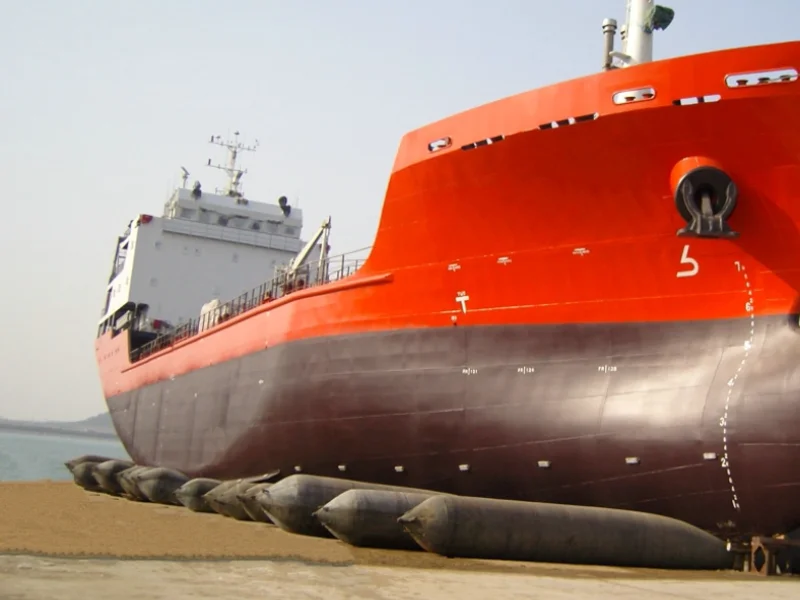
QP, QG & QS — Bearing Capacity by Cord-Layer Count
We classify ship launching airbags by the number of synthetic-tire-cord layers, because the layer count sets the safe working pressure and therefore the bearing capacity per metre of contact. More layers carry more load, so the type follows your vessel weight rather than a default.
| Type | Cord layers | Positioning |
|---|---|---|
| QP — General Purpose | 3 – 5 layers | Lighter vessels and general launching / haul-out |
| QG — High Bearing Capacity | 6 – 8 layers | Heavier vessels needing higher working pressure |
| QS — Super-High Bearing Capacity | 9+ layers | Larger vessels and heavy structure transport |
Standard diameters run from 0.5 m to 3.0 m with effective lengths up to 32 m, and special sizes are available on request. Effective length is the cylindrical working length and excludes the cone-shaped ends; we confirm diameter, effective length, and layer type together, because all three feed the bearing capacity calculation.
Bearing capacity per unit length — 6-layer (QG) build, by diameter & working height
Bearing capacity per airbag rises as the airbag is compressed: a lower working height means a wider contact patch under the hull, so the load carried per metre of length increases. The total bearing capacity of one airbag is the value below multiplied by its effective length.
| Diameter | Working pressure | Working height (m) | Bearing capacity (kN/m) | Bearing capacity (t/m) |
|---|---|---|---|---|
| D = 1.2 m | 0.17 MPa | 0.7 | 133.61 | 13.62 |
| D = 1.2 m | 0.17 MPa | 0.6 | 160.30 | 16.34 |
| D = 1.5 m | 0.13 MPa | 0.9 | 122.63 | 12.50 |
| D = 1.5 m | 0.13 MPa | 0.8 | 143.03 | 14.58 |
| D = 1.5 m | 0.13 MPa | 0.7 | 163.43 | 16.66 |
| D = 1.8 m | 0.11 MPa | 1.1 | 120.96 | 12.33 |
| D = 1.8 m | 0.11 MPa | 1.0 | 138.22 | 14.09 |
| D = 1.8 m | 0.11 MPa | 0.9 | 155.59 | 15.86 |
| D = 1.8 m | 0.11 MPa | 0.8 | 172.85 | 17.62 |
| D = 1.8 m | 0.11 MPa | 0.7 | 190.22 | 19.39 |
The figures above are for the 6-layer (QG) build. A 4- or 5-layer airbag of the same diameter runs at a lower working pressure and carries roughly 65–85% of these values, so the layer class has to be fixed before any capacity figure means anything. These are representative diameters; others are available on request. We confirm the working height and pressure your launch will actually run at, because the same airbag carries very different loads at different compression states — reading a single capacity figure without its working height and layer class is the most common sizing error we see.
Have your vessel weight and slope?
Send them over and we calculate the airbag type, size and quantity for your launch.
What Sets the Number & Size of Airbags You Need
The controlling variables are the vessel’s total launch weight, the ground slope, and how many airbags are actually in contact under the hull at the critical moment of the launch — not the diameter of a single bag.
Stern-first water entry is the critical moment. We size the set so the airbags in contact at stern-first water entry carry the load with margin, because that transition is where the bow airbags can be overloaded if the count is set from total weight alone. We work through vessel weight and dimensions, slipway slope and surface, water depth, and the launch sequence before fixing the airbag type, diameter, and quantity — and we confirm the ground is free of sharp objects and the slope is workable, since both affect airbag life and launch safety.
Not sure if airbag launching suits your site?
Tell us your slipway slope and ground condition — we confirm the method before you commit.
Standards, Type Approval & Testing We Confirm
We build ship launching airbags to ISO 14409, the product standard for ship launching air bags, while the launching operation itself follows ISO 17682, the methodology standard — these are two different documents and we keep them distinct in any specification.
Gas-tightness test
Confirms the airbag holds its rated working pressure.
Compression & recovery
Compression test plus compression-recovery under load.
Bearing capacity test
Verifies the load carried per metre of contact at rated conditions.
Bursting test
Confirms the safety margin over rated working pressure.
Type approval confirmed per project. Type approval is demonstrated to an independent class society; we confirm which approval and witness apply to your project rather than assert a society we cannot tie to your order, and our certifications are current and available on request. Factory testing under ISO 14409 includes dimensional checks at rated working pressure (typically within ±3%), with rated pressure and deformation tolerances confirmed on the data sheet. We confirm which tests you require witnessed before production, because witnessed testing affects the build schedule.
Need ISO 14409 type-approval documentation?
We confirm the approval and witnessed testing your project requires, then quote.
What Affects Airbag Service Life
Service life depends on usage frequency, storage, and ground conditions, and runs in the range of several years with correct care; airbags should be cleaned, dried, and stored away from oil, solvents, and sunlight.
We confirm your launch frequency and storage so the layer type we recommend matches the duty cycle rather than just the next launch.
Where Airbag Launching Is Not the Right Method
Airbag launching is not the right method for every vessel or site, and we will say so: very large or unusually shaped hulls need a full launch-engineering study before any airbag set is committed, and sites with steep slopes, soft ground, or sharp surfaces need preparation first or a different method.
The mistake we regularly correct. A buyer orders airbags by vessel tonnage alone, without accounting for ground slope and the number of bags in contact at stern entry — which is the moment that governs whether the launch is safe.
If your need is dedicated berthing protection rather than launching, an airbag is only a secondary fender; our pneumatic fenders are the right product for that, with rubber fenders for fixed berths and foam-filled fenders for permanent floating service. For below-waterline submarine berthing see our submarine fenders.
Frequently Asked Questions
How do I know how many airbags I need?
The number follows your total launch weight, the airbags in contact under the hull, and a safety margin — not the diameter of one bag. Send us vessel weight, dimensions, and slipway slope and we calculate the type, size, and quantity.
What is the difference between QP, QG, and QS?
They differ by cord-layer count: QP has 3–5 layers, QG 6–8, and QS 9 or more, with bearing capacity rising as layers increase. We match the type to your vessel weight and working pressure.
What is “effective length”?
Effective length is the cylindrical working length of the airbag and excludes the cone-shaped ends. We size effective length together with diameter and layer count, since all three set the bearing capacity.
Which standard applies — ISO 14409 or ISO 17682?
ISO 14409 is the product standard for the airbags themselves; ISO 17682 is the methodology standard for the launching operation. We build to the first and align the launch plan with the second.
Send Your Launch Data For a Sized Airbag Set
To get a sized recommendation, send us the data on the right. We will return an airbag type, diameter, effective length, and quantity with the engineered bearing capacity confirmed — and tell you plainly if your site needs preparation or a different method before launch.
What to send us
5 inputsYou get back: an airbag type, diameter, effective length and quantity with engineered bearing capacity confirmed — or a plain note that your site needs preparation or a different method.