
Cylindrical Rubber Fenders for Quays, Dolphins & Workboats
We manufacture hollow extruded cylindrical rubber fenders that absorb berthing energy through a progressive reaction force as the cylinder deflects, spreading the load around the circumference to protect the quay and the hull. We build outer diameters from 150 to 2,000 mm with bores from 75 to 1,000 mm and lengths up to 20 m, joined in sections for longer runs, with rated reaction force from 44 to 1,054 kN and energy absorption from 1.5 to 584 kN·m across standard and high-reaction grades. The fenders mount by chain, rod-and-bar, or ladder fittings, horizontally, vertically, or diagonally, and we have manufactured marine fenders in Qingdao since 2005. Classification-society type approval is available on request.
Where Cylindrical Rubber Fenders Earn Their Place
Cylindrical rubber fenders suit quays, dolphins, and workboats that need a simple, durable fender with a wide contact face — provided the berthing energy and the mounting are confirmed. We use them on commercial and naval berths, offshore platforms, and inclined or straight quay faces, and we size the diameter, length, and grade from your berthing energy rather than from outer diameter alone.
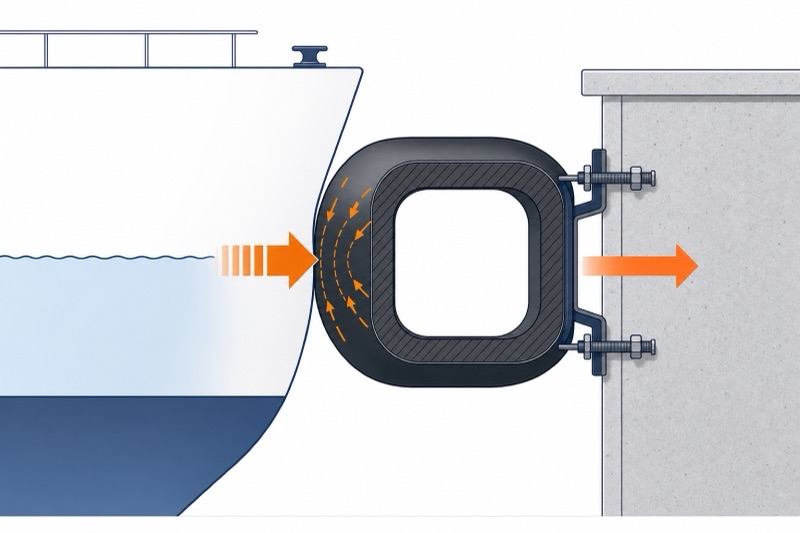
How the fender absorbs energy
The fender is a hollow rubber cylinder. As a vessel pushes against it, the cylinder deflects and flattens, and the reaction force rises progressively with deflection while the energy is absorbed and spread around the circumference. The uniform section avoids stress concentration, so the load is shared rather than point-loaded into the hull or the wall.
A cylindrical fender trades peak energy efficiency for simplicity and a wide contact face: it is versatile, easy to mount in several ways, and cost-effective, but it absorbs less energy per unit of reaction force than a cone or cell fender. We weigh that trade-off against your berth before recommending it.
Why a cylindrical fender over a cone or cell. The cylinder is simple, mounts horizontally, vertically, or diagonally, gives a wide contact face, and is cost-effective for general berths and workboats. The trade-off is lower energy absorption for a given reaction force; where a berth needs high energy at a controlled reaction, a super cone or super cell rubber fender fits better.
Commercial ports & terminals
A wide contact face for large cargo and passenger vessels on straight or inclined berths, where simple, durable protection matters.
Military & naval facilities
Mixed vessel types and varied berthing, handled with high energy absorption and durable rubber for reliable berthing.
Offshore platforms & oil and gas
Abrasion and corrosion resistance to hold performance in high-salt, chemically aggressive offshore environments.
Reaction Force & Energy Absorption by Size
Cylindrical fenders are selected on berthing energy, with reaction force kept within the quay’s and hull’s limits. The table gives rated reaction force (kN) and energy absorption (kN·m) per metre of length at 50% deflection, tolerance ±10%, for each size in standard and high-reaction grades — reaction force is the load passed to the structure, energy absorption is what the fender soaks up. We size against your berthing energy, typically on PIANC guidance, and apply temperature and angular correction factors for your site.
Reading the table — rated values. The figures are rated performance at 50% deflection per metre of length (±10%); real rubber fenders derate with temperature and with the berthing angle, so we apply temperature and angular correction factors to your case rather than reading the table straight. The standard and high grades give two reaction levels at the same size; hull pressure (kPa) is not listed and is confirmed separately against the contact area.
| Size OD × ID (mm) | Standard R (kN) | Standard E (kN·m) | High R (kN) | High E (kN·m) | Weight (kg) |
|---|---|---|---|---|---|
| 150 × 75 | 44 | 1.5 | 73 | 2.3 | 17 |
| 200 × 100 | 60 | 2.6 | 95 | 4.2 | 31 |
| 250 × 125 | 75 | 4 | 120 | 6.5 | 48 |
| 300 × 150 | 89 | 6 | 143 | 9 | 69 |
| 350 × 175 | 104 | 8 | 167 | 13 | 94 |
| 400 × 200 | 119 | 10 | 191 | 17 | 123 |
| 500 × 250 | 148 | 16 | 239 | 26 | 191 |
| 600 × 300 | 179 | 24 | 286 | 37 | 275 |
| 700 × 350 | 208 | 31 | 334 | 50 | 376 |
| 800 × 400 | 237 | 41 | 383 | 66 | 490 |
| 900 × 450 | 268 | 52 | 430 | 84 | 620 |
| 1000 × 500 | 297 | 64 | 479 | 103 | 766 |
| 1100 × 550 | 331 | 77 | 528 | 129 | 926 |
| 1200 × 600 | 363 | 95 | 574 | 152 | 1102 |
| 1300 × 650 | 392 | 108 | 623 | 179 | 1294 |
| 1400 × 700 | 422 | 128 | 670 | 208 | 1501 |
| 1500 × 750 | 451 | 147 | 718 | 238 | 1723 |
| 1600 × 800 | 481 | 176 | 776 | 282 | 1960 |
| 1700 × 850 | 511 | 206 | 824 | 338 | 2213 |
| 1800 × 900 | 541 | 247 | 872 | 406 | 2481 |
| 1900 × 950 | 570 | 288 | 920 | 487 | 2765 |
| 2000 × 1000 | 653 | 321 | 1054 | 584 | 3063 |
Rated reaction force and energy absorption by size, in standard and high-reaction grades; values are nominal and are corrected for temperature and berthing angle per project. Length is built to order up to 20 m and joined in sections beyond that. Values are per metre of fender length at 50% rated deflection, with a performance tolerance of ±10%; for other lengths, multiply the 1,000 mm figures by the length factor. Other sizes can be produced to order. Hull pressure is confirmed separately against the contact area.
The most common sizing mistake. Taking the rated energy straight off the table without temperature and angle correction. A cold fender is stiffer and an angled berthing compresses unevenly, so the in-service energy and reaction can differ from the rated figure. We apply the correction factors and check reaction force and hull pressure against your structure and hull.
U-Anchors, Chains, Shackles & Support Bars
A cylindrical fender is held entirely by external hardware, so the anchor, chain, shackle, and support bar are sized with the fender rather than chosen afterwards. The tables below give reference dimensions; final drawings are produced from your structural details.
Cast-in U-anchor dimensions
| Fender size (mm) | Φd | L | R | ΦG | T |
|---|---|---|---|---|---|
| 100–400 | 40 | 600 | 70 | 100 | 20–30 |
| 400–700 | 50 | 650 | 80 | 110 | 20–30 |
| 700–900 | 55 | 730 | 90 | 120 | 20–30 |
| 900–1100 | 60 | 780 | 100 | 140 | 25–35 |
| 1100–1500 | 65 | 830 | 105 | 150 | 25–35 |
| 1500–2000 | 70 | 880 | 115 | 160 | 25–35 |
All dimensions in mm and for reference only; the final drawing is designed from the detailed data you provide.
Small cylindrical fenders — chain & shackle (≤ Φ700 mm)
Small cylindricals up to about Φ600 mm are normally suspended on chains from cast-in U-anchors or chain brackets on the quay, with no through-rod.
| OD (mm) | ID (mm) | Chain (mm) | Shackle (mm) |
|---|---|---|---|
| 100 | 50 | 14 | 16 |
| 150 | 75 | 16 | 16 |
| 200 | 100 | 18 | 19 |
| 250 | 125 | 20 | 22 |
| 300 | 150 | 24 | 28 |
| 350 | 175 | 26 | 28 |
| 400 | 200 | 28 | 35 |
| 500 | 250 | 32 | 38 |
| 600 | 300 | 36 | 44 |
| 700 | 350 | 36 | 44 |
Large cylindrical fenders — support bar, chain & shackle (Φ800–Φ1600 mm)
Large cylindricals from about Φ900 to Φ1600 mm use a support bar through the bore, connected at each end to chains running back to U-anchors or brackets. Hardware is sized by fender length as well as diameter.
| OD (mm) | ID (mm) | Length L (mm) | Support bar ΦB (mm) | Chain (mm) | Shackle (mm) |
|---|---|---|---|---|---|
| 800 | 400 | 1000 | 900 | 24 | 35 |
| 1500 | 900 | 28 | 45 | ||
| 2000 | 900 | 32 | 55 | ||
| 2500 | 900 | 34 | 65 | ||
| 3000 | 900 | 40 | 70 |
Chain, shackle, and support-bar sizes increase with both diameter and fender length; full tables for Φ800–Φ1600 mm and lengths 1,000–3,000 mm are issued with the project drawing. Very large cylindricals of Φ1600 mm and above generally need a specially designed ladder bracket because of their weight.
Mounting by size. ≤ Φ600 mm: chain suspension from U-anchors or chain brackets. Φ900–Φ1600 mm: support bar through the bore with chains to brackets or anchors. ≥ Φ1600 mm: specially designed ladder brackets, engineered for the weight and the berth.
Know your berth and vessel?
Send displacement, approach speed, berth type, and temperature range — we size the fender and grade.
Construction & How They Are Mounted
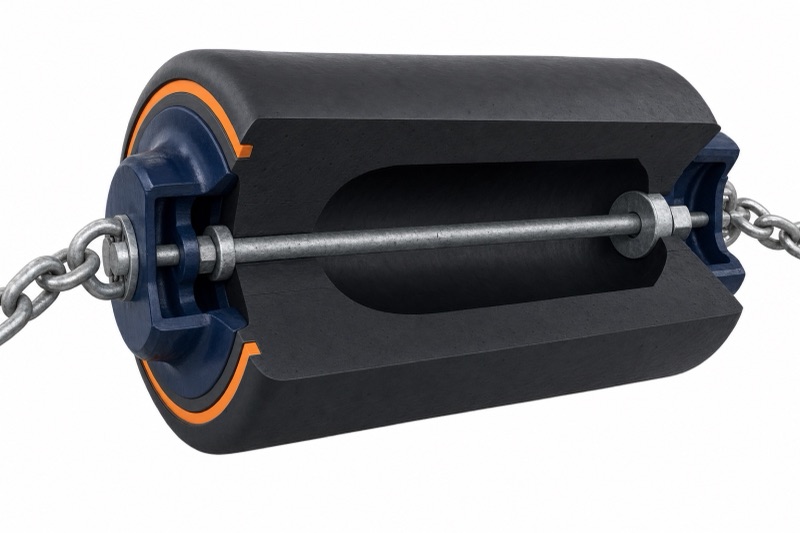
Thick-walled, hollow extruded rubber
The fender is a thick-walled, hollow rubber cylinder, extruded and cured by an advanced vulcanization process for resistance to seawater, UV, and mechanical abrasion. The hollow bore is what lets it deflect progressively, and the body carries no embedded steel — it is fixed entirely by external hardware, which keeps it simple to install and replace.
How it is fixed depends on size and berth movement. Up to about Φ600 mm, chains through cast-in U-anchors or chain brackets are enough; from about Φ900 to Φ1600 mm a support bar runs through the bore with chains at each end; at Φ1600 mm and above the weight generally calls for a specially designed ladder bracket. We confirm the mounting hardware with the structure rather than leave it generic.
Rod-and-bar fitting
A steel bar through the bore tied to anchor points spreads load and resists sideways drift — suited to large vessels and fixed quay walls with little vertical movement.
Chain fitting
End chains with no centre rod, easy to handle and with less hardware in the bore — suited to dolphins, barges, and where the fender should follow the contact.
Ladder fitting
Multiple chains for large tidal range or heave, balancing tension across stable anchor points so the fender stays put through the tide.
When a Different Fender Fits Better
Cylindrical rubber fenders are one option in our wider rubber fenders range, built for simple, versatile, fixed-berth protection. They are not the most efficient fender for every berth, so here is where something else fits better.
You need high energy at low reaction
For large vessels needing high energy absorption at a controlled reaction force, a super cone or super cell rubber fender is more efficient than a cylinder.
You are fendering workboats or tugs
For the gunwales and bows of tugs and workboats, tug boat fenders are shaped for that duty.
You have a floating berth
For a floating fender that rises with the tide rather than a fixed one bolted to a wall, a pneumatic fender or foam filled fender suits better.
An honest boundary. A cylindrical fender absorbs less energy per unit of reaction force than a cone or cell type, so on a high-energy berth it can mean a larger, heavier unit or a higher reaction into an old quay. Where energy efficiency or a strict reaction limit drives the design, we will say so and point you to the fitter type.
Cylindrical Rubber Fenders — Frequently Asked Questions
What sizes do cylindrical rubber fenders come in?
Outer diameters from 150 to 2,000 mm with bores from 75 to 1,000 mm, and lengths up to 20 m joined in sections for longer runs. Rated reaction force runs from 44 to 1,054 kN and energy absorption from 1.5 to 584 kN·m across standard and high grades.
How are they mounted?
By size and berth movement. Up to about Φ600 mm a chain through the bore is enough; Φ900–Φ1600 mm uses a support bar with end chains; Φ1600 mm and above generally needs a specially designed ladder bracket. They can mount horizontally, vertically, or diagonally with rod-and-bar, chain, or ladder fittings.
What is the difference between the standard and high grades?
The two grades give two reaction levels at the same size — the high-reaction grade carries more reaction force and energy for the same outer diameter. We match the grade to your berthing energy and the reaction limit of the structure.
Do temperature and berthing angle change the performance?
Yes. The table values are rated; a colder fender is stiffer and an angled berthing compresses it unevenly, so we apply temperature and angular correction factors to the rated figures rather than reading them straight.
What approvals are available?
Classification-society type approval is available on request. We confirm which approvals apply to your scope rather than publishing a fixed certificate list, and provide the documentation your project needs.
When should I use a cone or cell fender instead?
When the berth needs high energy absorption at a controlled reaction force. A cylinder is simple and versatile but less energy-efficient; a super cone or super cell fender delivers more energy at a lower reaction for large vessels.
Size the fender on energy, reaction and temperature
A cylindrical fender is right when its rated energy — corrected for temperature and angle — covers your berthing energy while reaction force and hull pressure stay within limits. Send us the berth and vessel and we return the size, grade, and mounting.
What to send us
6 inputsYou get back: a recommended size, grade, and length with corrected reaction force and energy absorption, and the mounting method for your berth.